Why Good R+ Dog Training Is So Fucking Boring to Watch
By Nando Brown
TikTok trainers, TV trainers and the uncomfortable difference between being good on camera and being good with dogs.
A video landed in front of me on TikTok recently that opened by calling out R+ trainers and asking why we apparently go very quiet when dogs “like this” show up.
So I responded, not because I knew who the bloke was, because I didn’t, and not because I thought the original training could not work. I used to be a balanced trainer myself when I started more than twenty years ago, so I understand perfectly well what that style of training is trying to achieve.
My point was much simpler. The reason reward-based trainers often do not produce the same kind of dramatic footage is because the process looks fundamentally different.
A balanced trainer may work much closer to the point where the dog reacts, and in some cases deliberately bring the unwanted behaviour into the session so it can be interrupted, corrected or otherwise worked through. A reward-based trainer will usually spend far more time trying to keep the dog below that point in the first place, using distance, stimulus intensity, classical conditioning, counterconditioning, reinforcement and environmental management to change how the dog responds before the explosion happens.
Neither approach is bulletproof. Sometimes reward-based work takes longer and sometimes it does not. Sometimes dogs still go over threshold despite your best planning. But when it is done well, it can make absolutely terrible social media content.
You can end up watching somebody sit twenty metres away from another dog, throw bits of cheese around, wait for a glance back at the handler, move a little closer, throw more cheese and then go home without anything particularly dramatic happening. As a TikTok video, it is fucking boring. As behaviour modification, that may be exactly the point.
The bit that happens before the explosion
“Threshold” gets thrown around a lot in dog training, sometimes as though there is a neat line where the dog is fine on one side and completely unavailable on the other. Real dogs are messier than that, but the concept is still useful.
In practical terms, I am talking about the point where the dog’s emotional arousal starts interfering with the behaviour I am trying to change. The dog can still see the person, still notice them and still have feelings about them, but I have enough room left to work.
I also want to be specific here because the original video was about aggression towards people, not dog-to-dog reactivity. The trainer was working extremely close to the dog. At that distance, the reaction was hardly an unfortunate accident in the training plan. The setup made a significant response extremely likely, and that response then became the thing being worked on.
That is fundamentally different from how I would usually approach the same problem now.
If I am working with a dog showing aggression towards people, I do not need the dog to launch at somebody before I can start changing the behaviour. I can manipulate distance, duration and intensity, use environmental management to create enough safety, and then use classical conditioning, counterconditioning and reinforcing alternative more appropriate behaviour to begin changing what the presence of that person predicts and what the dog does next.
That is not avoiding the problem. That is the treatment.
There is another bit of dog training language worth clearing up here, because I regularly hear people talk as though reward-based trainers do not use punishment. We absolutely can.
Punishment is not a dirty word in learning theory. It simply means that a consequence decreases the behaviour, in the future. Negative punishment, sits perfectly comfortably inside reward-based training. If play stops when teeth hit skin, for example, and biting subsequently decreases, that consequence has functioned as punishment.
So my objection is not “punishment bad”. That is far too simplistic. Reward-based training is generally built around positive reinforcement and negative punishment, whereas training relying on positive punishment or negative reinforcement introduces aversive consequences or pressure. The technical word punishment tells you what happened to the future behaviour. It does not tell you whether you personally think the procedure was morally acceptable. We, as reward based trainers will inevitably use all parts of the Quadrant, intentional or not because the reality is, its overstated in dog training and behaviour modification and there is A LOT MORE to look at at. Learning theory is ONE of seven lenses we teach our behaviourists to look through when it comes to working with aggressive dogs.
The same applies to flooding. Flooding is another word that gets thrown around as though simply saying it settles the ethical argument. Traditionally, flooding means forced, prolonged exposure to a stimulus at an intensity that elicits the problematic response, with escape, avoidance, or stimulus reduction prevented. Less technically put, it means putting the dog overthreshold and not letting the dog get away with it. Dean does a deep dive on this during the behaviour bible and i have a feeling this blog is already going to turn into a beast.
It can change behaviour. I am not going to pretend it cannot just because I would rarely choose it now.
I have worked with dogs where high-intensity exposure was effectively unavoidable. Take a street dog from an unknown background, put it on lead so it cant escape, introduce unfamiliar people, handling, doors, vehicles and a completely different environment, and you cannot guarantee that every single exposure will sit beautifully below threshold. Sometimes the dog is going to be overwhelmed despite your best efforts.
I would distinguish that from deliberately creating a flooding exercise, though. If I intentionally put a dog extremely close to the thing it fears because I want the full reaction and then prevent escape until that reaction reduces, that is a very different decision from a rescue dog being temporarily overwhelmed because there was no realistic way of removing every difficult stimulus from its environment.
Traditional flooding would certainly not be my first port of call. Done badly, it can increase fear, create sensitisation and make the original problem worse. The fact that a dog eventually stops reacting also does not automatically tell us why it stopped. Habituation, learning, behavioural inhibition, learned helplessness and plain old fatigue can look very similar if all you are measuring is whether the dog is still kicking off.
There are also degrees of stupidity available here. I once watched a video of a trainer put owners and dogs in a circle, physically restrain the dogs and expose them to fireworks going off around them. That was an absolute car crash. Calling that “flooding” does not magically turn it into a sophisticated behaviour-modification procedure.
This is why I am not interested in pretending that a technique cannot work simply because I would not choose it first. The trainer in the original video later showed the same dog playing with him, and I have no reason to claim that did not happen. I used balanced methods myself for years. I know they can produce behaviour change.
The disagreement is about how we choose to get there, what risks we are prepared to take during the process, and what state we repeatedly put the dog in while learning takes place. My preference now is generally to create enough exposure for learning to happen without repeatedly manufacturing the full aggressive response I am trying to change. Which brings us back to why the footage looks so bloody boring.
Apparently I have never worked dogs like this
The original creator responded to my video, and I was genuinely expecting some pushback on threshold, flooding, punishment or the actual distinction I had made between the two approaches.
Instead, I discovered that I am apparently a shit dog trainer, that being on television a few times somehow disqualifies me from having worked serious aggression cases, and that the fact I am folically challenged is relevant to canine behaviour modification.
This was all quite entertaining, particularly because I had absolutely no idea who the bloke was before his video landed in front of me. I was apparently living rent-free in the head of someone whose name I did not know. That became apparent and his total loss of composure in his next video.
Buried underneath all of that, though, there was one point worth answering. He said there was no evidence of me working dogs like this. There is actually stacks of it. The problem, from a social media point of view, is that most of it does not look anything like his footage.
One case that immediately comes to mind was a South African Boerboel I worked with when I lived in Spain. His owner had died, a rescue contacted me, and the dog had already put three people in hospital. The police had been involved, and I was given roughly two hours to see whether I could get him out safely before he was going to be put to sleep.
He was around 65 kilos, seriously aggressive towards people, and nobody could safely approach him.
If you are imagining some dramatic training sequence where I walked in, challenged him, corrected the aggression and established who was boss, prepare to be disappointed. Most of the first forty minutes involved me sitting behind a glass door throwing pieces of hot dog over the top.
We cleared the entire area so nobody else was put at risk, gave him enough space to move without being forced into contact, and started changing what my presence predicted without giving him an opportunity to practise putting another person in hospital. Although i will happily admit, that was a gamble on my part.
Eventually I was able to get him out, load him safely and take him back to my kennels, where the longer rehabilitation started. There were no drugs involved and there was no magic moment where the aggression disappeared. It took work. Over time he became able to interact with people, play, and be around other dogs in ways that would have been completely unrealistic when I first met him.
I will link the full video here because you can watch the process rather than take my word for it.
The important point is that the dog was every bit as serious as the sort of dogs people claim reward-based trainers somehow avoid. The footage just is not as exciting because my first objective was not to make him show me everything he was capable of. I already knew he could bite. Three people had been to hospital. I did not need a demonstration. My job was to work out how to make another bite less likely while creating enough safety for learning to happen.
And yes, he still bit me!
I do not want to turn that Boerboel case into one of those tidy social media stories where the dangerous dog meets the right trainer, everything gets fixed, everyone claps and the credits roll, because that is not what happened.
After he had made a lot of progress and had been rehomed to a trainer, I was invited round for a barbecue. He also had significant resource guarding issues, and through a combination of management mistakes he ended up loose with a Kong that he was guarding. That wasn't the trainers fault, just to be clear.
We were keeping our distance, but somebody made another mistake and moved into the situation. The dog went to bite them, I stepped in, and suddenly I was the person dealing with a 65-kilo Boerboel coming at me properly.
He bit both of my arms and went for my face and neck more than once. I ended up in hospital.
At that point this was not a training session. There was no opportunity for a beautifully planned counterconditioning protocol and I was not standing there thinking about the four quadrants of operant conditioning. I was trying not to get unalived by a dog only 15 kilos lighter than me.
I eventually had to physically pick him up and throw him over a fence to stop the attack.
I want to be crystal clear about that because somebody will inevitably read that sentence in isolation and decide my reward-based aggression protocol involves launching Boerboels over garden fences. It does not. This was emergency self-preservation during an active attack from a dog physically capable of doing enormous damage.
The incident also matters because it highlights something that gets lost in before-and-after dog training content. Behaviour modification can make a dog dramatically safer and easier to live with without turning that dog into an animal with zero risk.
Management still matters, context still matters, previous behaviour still matters and human mistakes still matter. That dog had made huge progress, but he still had a serious resource guarding history and the physical capability to make a management failure very expensive.
I continued working with him afterwards. That might sound strange to some people, but being bitten did not suddenly make everything we had done beforehand worthless, nor did it mean the only remaining option was to punish the aggression out of him. It told us something important about where the risk still existed and where the management had failed.
This is another reason I struggle with dramatic social media demonstrations as evidence that a dog is “fixed”. Seeing a dog playing with a trainer three videos later tells you something useful. It shows progress. It does not tell you what that dog will do six months later around food, in a different home, with different people, after somebody leaves the wrong door open.
Real aggression cases are rarely that neat.
There are plenty more cases, they just do not make great reels
The Boerboel is one example, but it is not the only one.
Another was a Pit Bull I worked with who had serious aggression towards other dogs. That entire case is laid out inside the Behaviour Bible, including the training, the progression, the decisions I made and, importantly, the bits I got wrong.
I think that last part matters. I could cut together a short before-and-after clip, show you the worst behaviour at the beginning, the finished dog at the end and conveniently remove everything in between that made me look less clever. Social media is very good at that.
I would rather show the whole case.
There were things I tried that worked. There were things I would approach differently now. There were moments where my timing, planning or judgement could have been better. That is what real behaviour work looks like when you follow a case over time rather than filming a few dramatic sessions for Instagram or tiktok.
That dog eventually went on to live successfully with other dogs in Scandinavia, which would have been very difficult to imagine when I first met him.
Between that case, the Boerboel and more than twenty years working with rescue dogs, biters, resource guarders and dogs displaying serious aggression towards people and other dogs, I am fairly comfortable that my lack of TikTok footage showing dogs repeatedly trying to eat me is not evidence that I have avoided difficult cases.
There is one thing I will not claim, though. I do not have direct experience with the specific Bull Herder type the original creator was talking about. I have worked with plenty of powerful breeds and dogs with serious genetic predispositions towards behaviours that can become dangerous, but I am not going to pretend experience I do not have simply to win an argument on the internet.
But what about the Bull Herder genetics?
There is one part of his argument that I actually find interesting, and that is the genetics.
I have already said I have not worked directly with Bull Herders, so I am not going to pretend otherwise. Instead, I went away and looked at what we actually know about them.
The first problem is that a Bull Herder is not really a standardised breed. It is a working type. Depending on who bred it, you might have Malinois, Dutch Shepherd, Pit Bull, AmStaff, American Bulldog or various combinations of those dogs in the mix.
So straight away, talking about “Bull Herder genetics” as though there is one Bull Herder genome is a problem. That does not mean genetics are not important. They absolutely are.
We have very good evidence that genetics influence behavioural traits in dogs, including stranger-directed aggression, chasing, trainability, fearfulness and plenty of other characteristics. We also know that if breeders keep selecting dogs for particular behaviours generation after generation, those populations change. You do not need a Kennel Club breed standard for that to happen. You just need to keep breeding the dogs that show the characteristics you want.
If you are deliberately selecting dogs for high arousal, persistence, strong nerves, physical engagement, bite commitment and the ability to keep working under pressure, of course that matters.
Where I think the argument falls apart is when we jump from that to saying those genetics somehow mean counterconditioning will not work.
I cannot find evidence for that.
And I should probably correct something I said in my TikTok response here, because I massively oversimplified counterconditioning myself. I said something along the lines of sitting on the other side of a fence and throwing cheese at the dog.
That was me trying to make a point in a short video, but it makes counterconditioning sound like the entire technique is just chucking dairy products at an angry dog until it changes its mind. It is obviously more sophisticated than that.
The key is finding what actually has value to that individual dog.
For one dog, that might be food. But even saying “food” is ridiculously broad. Chicken might be irrelevant while liver is gold. Kibble might be useless while sausage changes the entire picture. You test it.
For another dog, food might barely register compared with a toy. For another, access to movement, play or chase may be vastly more valuable. The skill is finding the thing that really matters to that dog in that context and then using it intelligently. Some dogs are intrinsically reinforced by the combativeness of the situation itself. Pretending some dogs don't enjoy a tear up is shortsighted in my opinion.
That is one of the things people sometimes miss when they watch reward-based behaviour work and say, “That dog doesn't care about cheese.” Fine. Then stop fucking using cheese.
The principle is not “feed cheese near the scary thing”. The principle is that the trigger starts predicting something genuinely valuable to that animal, while you control the intensity of the exposure well enough for learning to take place. And yes, genetics can make that much harder.
Genetics can influence how quickly a dog arouses, what it notices, how persistent it is, how readily it disengages, how suspicious it is of strangers, how rewarding it finds biting or chasing, how quickly it recovers and probably hundreds of other things we have not even properly mapped yet.
All of that changes the behaviour plan.
It may mean I need more distance. It may mean I need less distance. It may change what I use as reinforcement. It may mean the steps between exposures have to be tiny. It may mean management has to be incredibly strict. It may mean the realistic end point for that particular dog is completely different from the end point for a Labrador with the same apparent problem.
But that is very different from saying the laws of learning no longer apply because someone crossed a Malinois with a bull breed.
There is another problem with the aggression argument too. Aggression is not one thing.
Dog-directed aggression is not stranger-directed aggression. Resource guarding is not predatory behaviour. Defensive aggression is not trained biting. A dog bred to engage a human confidently in protection sport is not automatically a dog that wants to attack random members of the public.
The genetics literature is actually really useful here because it repeatedly shows that behavioural traits need to be separated rather than lumped together under one heading called “aggression”.
That is also why I am sceptical of anybody claiming Bull Herders rank particularly highly for human-directed aggression. As far as I can find, the population-level data simply are not there. We struggle to calculate reliable breed-specific bite rates for recognised breeds in the UK, never mind a loosely defined working cross that might be recorded by police or hospitals as a Malinois cross, Dutch Shepherd cross, bull breed cross or simply a mixed breed.
None of that means I would treat the genetics casually. Quite the opposite.
If you deliberately combine working populations and then repeatedly select the offspring showing the most intensity, persistence, physical engagement and commitment to biting, you can absolutely shift the behavioural characteristics of that population over time.
And if you combine those genetics with poor early socialisation, chaotic rearing, inappropriate handling or somebody deliberately rehearsing aggression, you could end up with an extremely difficult dog.
I think Bull Herders would actually be fascinating to research properly.
My suspicion, and this is a hypothesis rather than me pretending the research already exists, is that the interesting finding would not be that they have some generic “aggression gene”. I suspect certain working lines would contain a greater proportion of dogs sitting towards the extreme end of several traits at once: high arousal, high persistence, low avoidance, strong physical engagement and strong defensive responses.
Put those together in a powerful dog and the consequences when something goes wrong can be enormous.
That makes genetics enormously important. It still does not make learning theory optional.
If somebody can show me good evidence that Bull Herder genetics specifically prevent counterconditioning from working, I will happily read it and change my mind. I just have not been able to find it.
If you want the much nerdier version of this, I have a full video on canine behavioural genetics here:
We also cover the entire genetics section in the Behaviour Bible, including heritability, selective breeding, behavioural traits and the interaction between genes and environment: caninescience.co.uk/courses/behaviour-bible
Social media rewards the explosion
This is probably the bit that matters most.
Social media is built to reward visible change. A dog lunging, barking, snapping or trying to bite somebody creates tension immediately. Then the trainer steps in, does something, and a few clips later the dog looks calmer. That gives you a beginning, a conflict and a resolution in under a minute.
It is great content. Thats literally how Cesar Milan became a fecking millionaire.
The problem is that it can also create a completely distorted picture of what good behaviour modification is supposed to look like.
If my objective is to work below threshold, manage distance carefully and change the dog’s emotional response before the full aggressive behaviour appears, there may be very little drama to film. You might watch twenty minutes of a dog notice a person, eat some food, disengage, look back at the handler and then go home.
From a training perspective, that might be an excellent session. From a TikTok perspective, absolutely fuck all happened.
That creates a strange incentive for trainers who build their businesses through social media. The most visually impressive footage often comes from putting the dog close enough to the problem that something dramatic happens, because then the trainer gets an opportunity to visibly intervene. The audience sees the trainer doing something. If the trainer prevents the explosion from happening in the first place, the audience often sees nothing.
I am not suggesting every balanced trainer deliberately manufactures reactions for content, because that would be ridiculous. Plenty do careful work, understand thresholds and manage exposure intelligently. My point is that approaches which are more willing to work close to, or beyond, the point of reaction naturally produce footage that is more dramatic and much easier to sell online.
Reward-based behaviour modification has the opposite problem. Success can look like absence. No lunge, no bite, no explosion and no heroic intervention. That is much harder to make interesting.
And there are good and bad trainers on both sides of that fence. I have also seen people under the force-free banner avoid actually training the dog or modifying the behaviour because they have become so uncomfortable with concepts like control, boundaries or compliance that almost any expectation placed on the dog gets reframed as a welfare issue.
I do not buy that either.
The dog did not choose to live in our world, but he did not choose to be your pet in the first place. We have already made that decision for him, and that comes with a responsibility to teach him how to function safely within it.
If the word “training” makes you uncomfortable, call it teaching. I genuinely do not care. But if the alternative is never asking the dog to do anything difficult because he did not personally consent to modern society, then move to a mountain where nobody else lives, get off the internet and crack on.
Welfare matters enormously. Avoiding necessary learning and calling it welfare is something completely different.
It also means we need to be very careful when using training videos as evidence that one method can handle “real dogs” and another cannot. What you are seeing may tell you as much about where the trainer chose to work relative to threshold as it does about the severity of the dog.
The dog trying to bite the trainer on camera is not automatically a harder case than the dog calmly eating cheese thirty metres away. You need the history, the previous bite record, the trigger, the distance, the management constraints and what happens outside that edited clip before you can make that judgement.
I think this is why the argument that “you never see R+ trainers with dogs like this” has always been a bit backwards. Sometimes you do not see the dog behaving like that because preventing that rehearsal is part of the bloody training plan.
Good behaviour work is often designed to make sure the dramatic moment never happens at all.
did not start out as an R+ trainer
The reason I got into dog training in the first place was a Cane Corso that was completely out of my league.
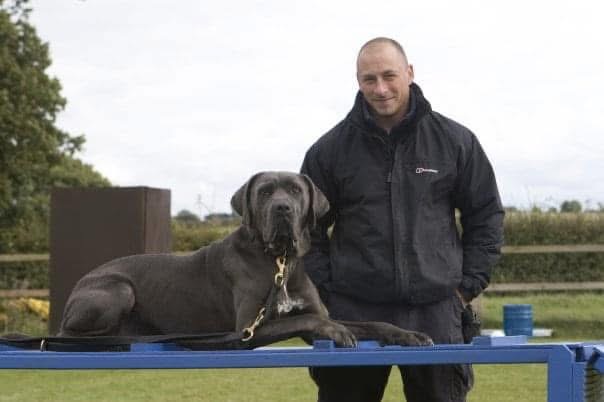
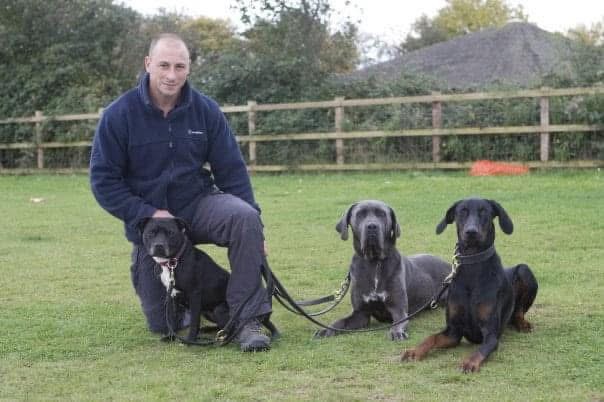
I loved that dog, but I did not know what I was doing with him. I had seen balanced trainers, reward-based trainers and people who claimed to understand serious behaviour problems, and I was not getting the help I needed.
One of the experiences that pushed me towards balanced training came after somebody had tried medication and what I now recognise as a counterconditioning protocol. The problem was not necessarily the principle behind what they were doing. The communication and support were terrible, and by their second visit they were suggesting that I put the dog to sleep.
The next trainer who came to the house was balanced. My dog lunged at her as she came through the door and she belted him.
I watched his entire demeanour change. It was basically, “Oh fuck, I cannot mess about with you.”
For someone desperate for an answer, that was incredibly convincing. I had spent all this time feeling as though nobody could control the situation, and suddenly somebody did something and I saw an immediate, obvious change in the dog.
That made my mind up.
I started shadowing balanced trainers, then working for them, then working for another training company, and eventually working for myself using the same methods. Prong collars, electric collars, choke chains and corrections were all part of the toolkit.
And I thought I was a good dog trainer.
That is relevant because the original creator of the TikTok video said something along the lines of me thinking I am a good trainer now. The truth is that I thought I was a good trainer then too. What I did not understand was how much I did not understand about reward-based training.
My Corso eventually bit someone in the throat. This was not some slightly difficult pet dog where I decided punishment felt a bit mean. He was a serious dog with serious behaviour.
Around that time I was trying to widen my education and ended up at a Sarah Whitehead clicker-training seminar. I was the only man in the room, it seemed to be full of women, and I remember walking in thinking, “What the fuck am I doing here? These are not my people.”
We were working with a 14-week-old Husky puppy. I followed the process Sarah had shown us and taught the puppy to lie down. Sarah had been watching me, came over and asked what I had taught the dog.
I gave it a bit of bravado and said, “Well, I have taught it to lie down.”
She said, “Have you?”
Then she pointed out what was actually happening. Every time I clicked, the puppy stayed in the down but shifted from one hip to the other without getting up. I had been reinforcing a tiny piece of behaviour that I had not even noticed.
That blew my fucking mind.
I remember thinking, hang on, there is an entire level of precision here that I do not understand. It was one of those moments where instead of thinking I had learnt another useful technique, I realised how much of the picture I was missing.
Around the same period, everything with my Corso came to a fairly brutal end.
He needed what should have been a routine ear examination, but his behaviour had become so difficult that the vets had to anaesthetise him just to examine him safely. While he was under, the vet rang me and explained that they had found serious disease affecting his body and that he was in enormous pain. They could wake him up if I wanted them to, but their view was that the kinder option was to let him go while he was already unconscious.
I rushed to the veterinary clinic and said goodbye to a five-year-old dog that I absolutely adored, without ever getting the chance to say goodbye to him properly.
Then came the guilt, because suddenly I was thinking about every correction I had given that dog while he may have been in pain.
I thought about the technique I was taught "taking his head off" on a choke chain. I thought about using a prong collar. I thought about back-tying him to a fence on a long line, calling him towards me and waiting for him to hit the end of the line so the collar delivered the correction as part of teaching an emergency stop.
At the time, I genuinely believed I was training him. Afterwards, I had to sit with the possibility that I had been physically hurting a dog who was struggling with something physical that neither I nor the people around me had properly understood.
That did not suddenly make every balanced trainer wrong or every correction useless. It did something much more important to me personally. It made me realise I knew fuck all compared with what I thought I knew. Between that experience and the clicker seminar, I decided I needed to go away and learn properly, and I did.
Over the years since, I have leaned much more heavily into reward-based training, behaviour science and the mechanics of changing emotional responses rather than simply changing what the dog does in front of me. That does not mean I stopped learning from people outside that world. I attended a seminar with Bart Bellon in Spain. I have sat through Michael Ellis lectures. I have continued to learn from trainers whose methods I do not necessarily use because understanding why something works is different from deciding whether I want to use it.
There are balanced trainers who know far more about balanced training than I do now, just as there are reward-based trainers who know far more than I do in their own specialist areas. Apparently, quite a few of the former are also on TikTok.
There is another reason I moved away from aversive tools
One of the biggest reasons I am uncomfortable with aversive training now has less to do with the dog and more to do with the human holding the lead. We are not particularly good at emotional regulation.
I have trained alongside plenty of balanced trainers over the years, and sooner or later I have seen a lot of very competent people lose their fucking rag. I have done it myself. You are tired, the dog has done the same thing for the twentieth time, the owner is frustrated, the session is going badly, and suddenly the amount of pressure you are prepared to use starts creeping upwards.
That matters when the equipment in your hand is specifically capable of causing discomfort or pain.
If I am in a fight and there is a gun sitting next to me, the existence of the gun changes the consequences of me losing control. The same principle applies here. A prong collar, electric collar or any other deliberately aversive tool may be used with enormous precision by somebody calm and skilled, but it is still there when that same person is frustrated, angry, embarrassed or trying to prove a point.
And dog trainers are still people.
That is probably one of the biggest changes in how I think about this now. Twenty years ago I focused almost entirely on whether the technique worked. Now I also ask what happens when the person using it has had a shit day.
There is already evidence that training relying heavily on aversive methods is associated with more stress-related behaviour in dogs, more tense behavioural states and, in some research, higher increases in cortisol after training compared with reward-based training. That does not tell us that every individual correction harms every dog, but it does mean the welfare consequences of getting this wrong are worth taking seriously.
The original TikTok creator has called me a cunt, a turd, an egghead, a baldy prick and a few other things in the comments since I responded to his video. I am not going to diagnose his emotional regulation from a TikTok argument, and I have no idea what he is like with dogs away from social media. But it does illustrate the wider point rather neatly.
People get angry, people become defensive, people take criticism personally and people escalate. If your training system gives you a tool whose entire purpose is to make an unwanted behaviour less likely by adding something unpleasant, then the emotional state of the person deciding how much unpleasantness to add becomes relevant.
That does not mean every reward-based trainer is some permanently calm monk either. We lose our rag too. The difference is that if I get frustrated while holding a handful of cheese, the potential damage from that loss of emotional control is considerably smaller.
For me, that matters.
So what am I actually arguing?
I am not arguing that balanced training does not work. I know it works because I used it for years, got results with it and built part of my early career around it. I am also not arguing that every dog should be kept twenty metres away from anything difficult while somebody throws cheese at it for the rest of its life.
The distinction I am making is about where you choose to do the majority of the work.
If I can change a dog’s response while keeping it below the point where it is repeatedly rehearsing serious aggression, that is generally where I want to start. I can manipulate distance, intensity and duration, change what the trigger predicts, reinforce useful behaviour and gradually increase the difficulty as the dog becomes more capable of coping with it.
I actually tend to work much closer to threshold than many other reward-based trainers would choose to, and sometimes it makes them uncomfortable. But that comes with its own set of pros and cons.
Sometimes that process is quick. Sometimes it takes ages. Sometimes you make mistakes and the dog goes over threshold anyway. Sometimes management fails completely and you end up dealing with the behaviour you were trying to prevent. Anyone claiming they can guarantee otherwise has not worked enough real cases.
There may also be situations where higher-intensity exposure is unavoidable, and there may be trainers who make different decisions from me about when punishment, pressure or flooding are appropriate. I can disagree with those choices without pretending the techniques are incapable of changing behaviour.
What I object to is the idea that the most dramatic video represents the most serious training, or that because an R+ trainer has not filmed themselves standing three feet away from a dog trying to bite them, they somehow do not work with dangerous dogs.
Sometimes the absence of that footage is the evidence of the approach.
The Boerboel did not need to prove to me that he could hospitalise somebody. The Pit Bull did not need another opportunity to demonstrate dog aggression so I could make an impressive before-and-after reel. In both cases, the interesting work happened in the space where we were trying to prevent those behaviours from being rehearsed while building something else instead.
That is also why I am far less impressed now by the appearance of control than I was twenty years ago. My Cane Corso taught me that a dog stopping a behaviour in front of you does not necessarily mean you understand why it was happening in the first place. Sarah Whitehead taught me that there can be layers of behaviour happening right underneath your nose that you are not skilled enough yet to see. And the late Sarah Fisher taught me that even after all these years, there are still things happening right in front of me that I can't even fucking see.
I still think about all of those lessons.
So when someone asks why R+ trainers “go quiet” around dogs like this, my answer is that we do not. Plenty of us work serious aggression cases. The sessions just often look completely different because we are trying to change what happens before the explosion rather than waiting for the explosion so we can demonstrate how well we handle it.
That makes worse TikTok. I am completely fine with that.
You can watch my original response to the video here: vm.tiktok.com/ZN8RDQwnB
You can watch the start of the Boerboel case here:
You can also watch my longer video on canine behavioural genetics here:
And if you want to see how I work through aggression cases in detail, including the decisions that worked, the mistakes I made, the genetics behind behaviour and the cases that did not fit neatly into a social media clip, that is exactly the kind of work we break down inside the Behaviour Bible: Explore the Behaviour Bible