Protection Sport Does Not Need Silence. It Needs Standards.
By Nando Brown
A working Mondioring decoy on the AVD e.V. trial near Slough, the reports circulating in the working dog world, and why the sport needs standards, not silence.
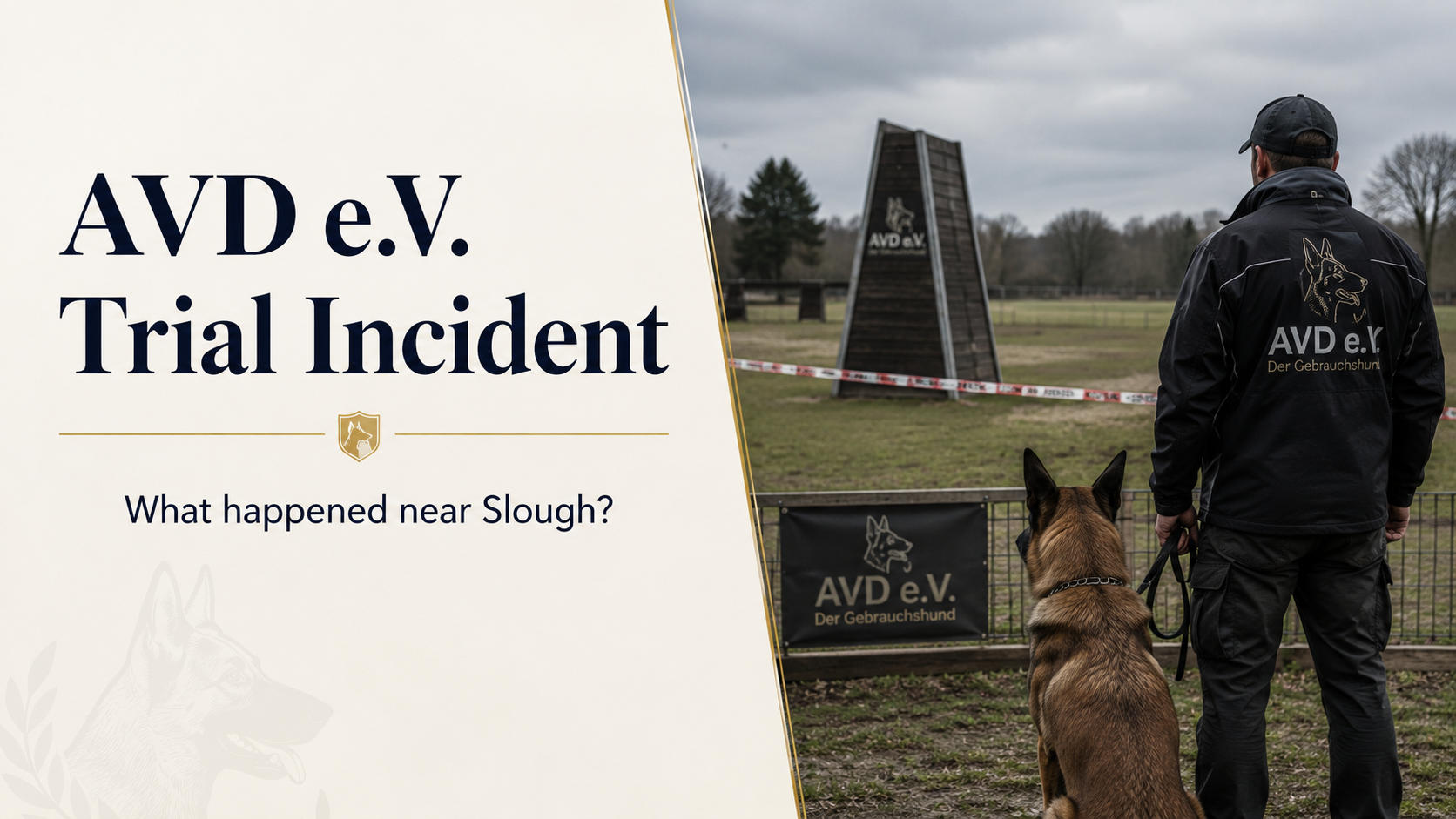
I want to be careful with this one. Not because I am unwilling to say what I think. I am not short of opinions on this subject. But because there are potentially serious legal proceedings connected to what I am about to discuss, and fairness matters even when the subject is ugly. Careful, honest, and direct. In that order.
My background in this world
I have been involved in bite work most of my adult life. I competed in Mondioring at a national level. I am a certified Mondioring decoy. I have dobbled in IGP, Working Trials and protection work and spent more time on bite fields than I can meaningfully count.
Beyond the sport side, I have had the opportunity to work alongside military and police units, including special forces teams. Not just alongside them. I have taught them and troubleshot problems. That context is important for what follows.
I say this because when I talk about protection sport, I am not doing so from the outside looking in with a welfare pamphlet in my hand. I am doing so as someone who has spent decades inside this world, who loves it when it is done properly, and who has no patience for the parts of it that are not.
I have worked with dogs that could genuinely hurt you. I have been the person in the sleeve screaming from a rooftop like a drunken criminal, the person in the bite suit trying his best to test dogs or build their confidence, and the person holding the lead working out what i can do to make my dogs next rep even better. I understand pressure, drive, thresholds, and the psychology of a dog working at the edge of its capacity. That context is everything for what I am about to say.
What has been reported
Earlier this year, an AVD e.V. trial was held at a working dog facility near Slough. Multiple public accounts, circulating across social media platforms including TikTok, Instagram, and Facebook, reported that one dog died and a second was severely injured, with some accounts suggesting it lost the use of an eye. I had never heard of AVD prior to this incident.
These are allegations. At the time of writing, no findings of guilt have been made. I am not in a position to verify the specific details of what took place, and I will not present unverified accounts as established fact.
What I can say is that the response from within the working dog community was significant. Several prominent figures, including those with many more serious credentials than myself, in protection sport, posted publicly calling the reports deeply troubling. The organiser's AVD membership was subsequently reported to have been revoked. Multiple accounts described the trial as operating with a level of secrecy that sits poorly with any genuine sporting culture. In Spain, where most of my experience is, protection sports are treated as a family event, the community turns up for barbeques and its an incredibly social event. Not a secret one.
I approached the RSPCA directly for comment. A spokesperson responded: "We're aware of this situation but we're unable to comment on specific incidents or investigations." They went further, though, and their wider statement is worth quoting in full, because it speaks directly to everything this piece is about:
"Regardless of a dog's background or role, their welfare needs must always be met, including during handling, training and public exhibition events. They should never be subjected to training methods or environments that cause fear, pain, distress or unnecessary suffering.
Aversive training techniques can negatively impact a dog's welfare and risk causing both physical and behavioural harm. That's why we're calling on governments to regulate animal trainers and behaviourists, including anyone involved in training or competition protection dogs or dogs involved in bite work.
All animal training should prioritise kind, compassionate, ethical and scientifically evidence-based methods, developed by appropriately qualified and regulated professionals, and an animal's needs must always be met in line with the Animal Welfare Act."
Read that statement again. A national welfare body with statutory prosecution powers is publicly calling for the same thing this piece is calling for: regulation, qualified oversight, and accountability for anyone doing bite work with dogs. That's not a coincidence, and it's not a small thing. When the RSPCA and a working Mondioring decoy who's spent his career in this world are making the same argument from opposite ends of the field, the case for standards gets a lot harder to dismiss as either welfare zealotry or industry defensiveness.
I will say that regulation is a messy messy world at the moment, as I wrote about in the RED TAPE of REGULATION blog you can find on the website.
I was also approached about providing expert witness work in relation to an RSPCA prosecution connected to the protection dog world. It was not made explicit that this prosecution relates directly to this trial. Given the timing and the subject matter, however, I would be surprised if they were unrelated.
I declined. Partly because I had no wish to be pulled into the case. Partly because I knew the footage involved would affect me, and I had no appetite for that. Protecting dogs matters. Protecting your own head matters too. I don't need to see a video of a dog dying to know that its dead.
AVD is not Mondioring. It is not IGP. It's important you understand this if you're not involved in protection sports.
AVD e.V. is not part of the FCI-affiliated working dog sport structure. It is not IGP. It is not KNPV. It is not Mondioring, French Ring, or any of the established international bite sports that have developed over decades with judging standards, decoy certification requirements, welfare protocols, and independent oversight. They all have their own pros and cons because they are not the same as eachother either.
AVD e.V. is a German-origin breed club organisation, centred primarily on molosser-type breeds such as the Dogo Canario, Presa Canario, and Cane Corso, that runs its own internal working trial format. Based on my research, it has no clear affiliation with the major German cynological bodies, and the only UK member of the club was the organisation running the trial in question.
That is a very thin governance structure. One club. No independent oversight. No external judging body with meaningful accountability. No certified decoy standard tied to an internationally recognised federation.
This opacity is not incidental. AVD's own structure bakes it in. At silver and gold level, recording is not permitted. No footage, no accountability, no external reference point for what took place. Since the Slough incident, it has been reported within the community that spectators are now banned from gold level entirely.
Think about what that means. The highest level of the trial, where the most extreme pressure is applied to dogs, is now the level that fewest people outside the immediate participants will ever see. That is not a sport tightening its welfare standards. That is a sport removing its remaining witnesses.
When something goes wrong in a sport with that structure, there is nobody external to answer to. That is not a coincidence. It is a feature.
What good decoying actually is
A good decoy is one of the most skilled jobs in working dog sport. When it is done properly, it is a genuine art.
The decoy reads the dog. They manage pressure. They control the timing of engagement and escape. They understand threshold, arousal, and recovery. They know when to be still and when to move, when to increase difficulty and when to back off. They take the bite in a way that rewards the dog's work without injuring it. They protect themselves and they protect the animal. They have different jobs at different times. In training a good decoy will make your dog walk off the field having learnt the lesson with the confidence of a champion. In competition they will test to see how robust that dogs confidence is.
It is physically demanding, technically complex, and requires a level of understanding of canine behaviour that most people who have never done it significantly underestimate. All at a speed that most pet dog trainers just dont have the opportuity to experience.
Good decoying tests a dog's nerve, drive, and control. It does not harm the dog, physically or mentally.
A dog being put into a situation it cannot cope with, forced to continue when it is shutting down, or physically harmed by a decoy, is not a dog being tested. It is a dog being abused. Those are not the same activity dressed up differently. They are fundamentally different things.
What outsiders often misunderstand
Protection sport looks alarming to people who have not seen it up close. A dog biting a human forearm, leg or even chest. Barking at high intensity. Gripping and pulling. A dog that will not let go until told to.
I understand why that reads as aggression and danger to someone without context. But in a well-run protection sport environment, that same dog goes home and sleeps on someone's sofa. It is switched off. It is confident, not anxious. It has an outlet for drives it was born with, and clear rules about when those drives operate.
The barking is not panic. The grip is not violence. The intensity is not suffering. A dog working on a bite field with a skilled decoy, hitting a sleeve hard and coming off clean on command, is often doing exactly what its biology was shaped to do. It is engaged, aroused in the positive sense, and entirely within a structure it understands.
This is important to say, because the conversations that follow incidents like this one often collapse into a single position. Bite sport bad. Protection training cruel. All of it the same.
It is not all the same. Some of it is genuinely excellent, carefully managed, and beneficial for the dog. Some of it is not. The industry needs to be able to make that distinction loudly, rather than either defending everything or abandoning the field entirely.
Here is where I will be direct with the people inside this world, because frankly, some of you need to hear it. The secrecy has to stop.
There is a culture in parts of the working dog and protection sport world that treats criticism as betrayal, ranks-closing as loyalty, and transparency as weakness. It confuses hardness with quality. It mistakes ego for skill. It allows people who should not be working dogs at this level to continue, because calling them out feels like giving ammunition to outsiders.
That logic is backwards, and the consequences of it are now public.
If the reports from this event are accurate, dogs suffered. One may have died. The response from parts of the community was not accountability. It was silence, deflection, and in some cases, active hostility toward the people raising concerns before the event even took place.
The people who warned this would happen were right. The people who dismissed those warnings to protect the event need to think carefully about what protecting the event actually achieved.
Politics and ego are not standards. Closing ranks is not integrity. And sport that can only survive in private, away from scrutiny, is not a sport worth defending.
I do not want to see protection sport destroyed by association with the worst actors in it. I believe there is genuine value in working dog sport done properly. The physical and mental development it provides, the relationship between handler and dog, the preservation of working ability in working breeds. All of that is real and worth defending. I think that for some dogs it will be the difference between thriving in the real world and struggling with reactivity for the rest of it. My own Malinois Fizz turned a corner when we started protection work. To quote Alex Lato "if a dog can handle a man with a stick screaming, then walking past a man in the street is not even considered a problem anymore"
I competed in MMA around the same time I first picked up a bite sleeve. Nine fights, eight wins. And the thing that strikes me most, looking at protection sport from where I sit now, is how much more seriously combat sports take governance than parts of the working dog world do, despite the fact that MMA is, by design, two people trying to hurt each other.
There are weight classes, so competitors aren't mismatched into something dangerous. There are licensed referees with the explicit authority to stop a fight the instant it stops being a fair contest and starts being something else. There are ringside doctors. There are sanctioning bodies that can suspend or strip the licence of a fighter, a coach, or a promoter who crosses a line. None of that softens the sport. If anything, it's what allows it to stay as hard as it is while still being defensible to the public and to the people inside it.
Protection sport, done at its best, deserves exactly that same seriousness. It should not have a lighter governance structure than one. Right now, in parts of this world, it has almost none.
Every Mondio competition i turned up to had a Vet in attendance, the dogs were checked for health and paperwork and if a decoy hurt a dog he would be escorted off the field.
Certified decoys with externally verified standards. It means independent judging with accountability outside the organising club. It means welfare checks with teeth. It means that if something goes wrong, the sport answers for it publicly rather than retreating behind closed doors.
It means that the people who are doing this properly are willing to say, loudly and clearly, that what happened in Slough is not what they do, and here is the evidence for that distinction.
The RSPCA is already calling for exactly this: regulation of anyone involved in training or competing dogs in bite work, delivered by qualified, accountable professionals. When the prosecuting welfare body and the practitioners themselves are asking for the same thing, there is no longer a credible argument that regulation is an outside attack on the sport. It is what the sport needs to survive its worst actors.
I want to state clearly HOW that regulation is achieved is a incredibly difficult task. People with bad intentions, people with conflicts of interest and people that are just ignorant to the subject will all have to be navigated but silence is not a neutral position right now. Protection sport does not need silence. It needs standards. And the people in a position to set those standards need to decide whether they are going to do that, or whether they are going to let the worst version of this scene define the whole of it.
The dogs deserve better. So does the sport.
Arne Pohlmeyer, chairman of AVD e.V., and Sati Gill of 5K9 Working Dogs were both contacted for comment on two separate occasions, across two platforms. Neither responded.