Dog Trainer Regulation: It Sounds Simple Until You Try to Write the Rules
By Nando Brown
Singapore has written minimum standards for dog trainers. The UK is still talking about it. Here is why writing the rules is the hard part.

Listen to this article · read by Nando Brown
What can I do about regulation? ↓Dog trainer regulation has been talked about for years. Should anybody be allowed to call themselves a dog trainer? Should there be minimum standards? Should trainers have to demonstrate practical competence? Who decides which methods are acceptable, and who gets to decide whether somebody is qualified enough to work with the public in the first place?
Those questions are fairly easy to throw around while everything remains theoretical. It gets a lot harder when somebody actually has to sit down and write the fucking rules.
Singapore has now done that. It has not introduced a conventional licence that every dog trainer must hold, but in October 2026 it introduced specific minimum standards and best practices for dog trainers within its Code of Animal Welfare. The standards cover training methods, professional competence, supervision, continuing education, record keeping, informed consent, safety and referral. Failure to meet those minimum standards can also become relevant in animal welfare enforcement.
At almost exactly the same time, things have moved forward in the UK. The Responsible Dog Ownership Taskforce has recommended that government explores options for regulating dog trainers and behaviourists. It acknowledges that there are currently no mandatory professional standards and that experience, competence and methods vary massively across the industry. For now, though, the immediate recommendation is still evidence gathering. We do not have a finished regulatory system.
The Animal Behaviour and Training Council, or ABTC, has also been talking publicly about its recent work with UKAS and what that might mean for the future. I went much further into the organisations and paperwork behind some of this in Following the Paperwork: David Montgomery’s Regulation Blog Doesn’t Add Up, so I do not want to repeat that entire investigation here.
What interests me this time is slightly different.
In Britain, we are still talking about what regulation might look like, who might be involved, what standards might eventually be adopted and how those standards should be assessed. Singapore has actually written some down, which means we finally have something tangible to pull apart.
Reading what Singapore has produced has also made me appreciate something I probably have not said clearly enough in my previous articles about regulation. I do not envy the people trying to do this.
I have been critical of some of the conversations around regulation in the UK, and I probably will be again. But I would not want the job of writing these standards myself. In fact, people like me are probably exactly why I would not want the fucking job.
The moment somebody draws a line and says, “This is the minimum amount of experience a dog trainer should have,” I am going to ask why the line is there. If they say somebody must demonstrate practical proficiency, I am going to ask what practical proficiency actually means. If they require continuing professional development, I am going to ask whether the person genuinely became better at their job or simply collected enough hours to satisfy the requirement.
Once you start regulating a profession, apparently simple words like experience, competence, ethics and proficiency suddenly need definitions that can be applied to real people.
Singapore gives us something useful because we no longer have to argue entirely in the abstract.
One Year of Experience Sounds Clear Until You Think About What a Year Actually Means
One of the things that immediately caught my attention in Singapore’s new framework is the supervision requirement. A trainer with less than one year of documented dog training experience must work under the supervision of somebody with at least one year of documented dog training experience when handling clients’ dogs and communicating with clients about training.
I understand why somebody has tried to put a number on it. Regulation needs things that can be measured, and twelve months is wonderfully easy to measure. The problem is that I do not think twelve months necessarily tells you very much about competence.
When I think back to myself after one year in dog training, I had already done quite a lot on paper. I had spent months assisting classes, started taking classes myself, moved to another club and was taking classes there too. If you had looked at me from the outside, you could quite reasonably have said I was already working as a dog trainer.
The reality was that I had absolutely fucking no idea.
I could run a small class and teach some basic exercises, but I was still a baby in the game. I remember feeling out of my depth when problems came through the door that I had not seen before, and I knew I did not have the support around me that I needed. One of the things that genuinely worried me was that I could accidentally make things worse for somebody’s dog, not because I was trying to do anything reckless, but because I did not know enough yet to recognise what I did not know.
Under a simple time based system, the trainer I was at month thirteen could potentially have been considered experienced enough to supervise somebody at month eleven. I am not convinced that would have been good for either of us.
The bigger problem is that not all years are remotely equal. One person could spend twelve months working under an exceptional trainer, handling hundreds of unfamiliar dogs, being watched, corrected, reinforced for the things they are doing well and exposed to situations that constantly stretch their ability. Somebody else could spend twelve months mostly working their own dog, watching courses online and occasionally helping with a puppy class.
Both can truthfully say they have one year of experience. They have not necessarily had the same year.
Time served is easy to count. Competence is not, and the moment we move away from time and start asking people to demonstrate practical proficiency, we run into an even harder question.
What exactly are we asking them to demonstrate?
What Does Practical Proficiency Actually Mean?
Singapore’s code requires trainers to demonstrate knowledge of learning theory and the practical application of training and behaviour change. That sounds completely reasonable. The difficult bit is deciding what evidence tells us somebody can actually do it when there is a real dog in front of them.
Teaching a sit in a quiet room with a dog you already know is practical dog training, but I am not sure it tells me very much about whether you are ready to work independently with the public. What happens when the dog will not eat? What happens when you have always worked German Shepherd sized dogs and somebody hands you a pug? What happens when the Malinois you assumed would sell its grandmother for a tug is too stressed in the environment to play? What happens when the dog you planned for turns up as a completely different dog once you get it out of the car?
For me, practical competence is not just whether you can get a behaviour. It is whether you can read what is happening, make sensible decisions, adjust your criteria, change your reinforcement strategy, handle the dog safely and recognise when the plan you walked in with is not going to work. It is also knowing when to stop, when to ask for help and when the case has moved outside your own competence.
There is a depth problem as well as a breadth problem. Someone can become exceptionally good at training one dog because they have spent years refining the mechanics, reinforcement placement and criteria with that individual. Dog sport is brilliant for that. You can take a behaviour much further than most pet owners would ever need and learn an enormous amount from the mistakes you make along the way.
Someone working in rescue can develop almost the opposite skillset. They might handle dozens of unfamiliar dogs with completely different histories, emotional states, arousal levels and motivations. The dog in front of them does not care what worked yesterday, so they are constantly forced to adapt.
I do not think either is enough on its own.
I have gone into that much more deeply in Online Courses vs Hands-On Experience: The Blind Spots in Dog Trainer Education, because I think one of the biggest mistakes we make is looking for one pathway that somehow produces a complete professional.
It is also part of the thinking behind how we have structured our own practical education at the School of Canine Science. To be clear, we are an education provider. We are not a professional membership body, trade association or regulator, and I have absolutely no desire for us to become one.
Phase One of our immersion work goes deeper into the nuance of working and training, with feedback on what the trainer is doing rather than simply whether the dog eventually performed the behaviour. Phase Two deliberately introduces more breadth, with people working multiple unfamiliar dogs of different types, emotional states, arousal levels and training histories.
That does not mean completing those phases magically makes somebody a competent dog trainer. It means we think depth and breadth expose different weaknesses.
Supervision matters as well, partly because dog training can be a surprisingly lonely profession. Most of the time you are not working alongside other trainers. You are in somebody’s house, in a field, running your own classes or working one to one with a client. Unless you regularly train your own dog in a club, participate in a sport or have deliberately built a group of trainers around you, there may be nobody watching you work and very few opportunities for another professional to say, “Have you noticed you keep doing that?”
You can film yourself, and I think trainers should. Watching your own sessions back can be incredibly useful because things that felt completely different in the moment can suddenly become obvious on video. But you still do not know what you do not know. If you cannot see that your reinforcement placement is creating a problem, watching the video ten times does not guarantee you are suddenly going to recognise it.
That is one of the reasons we built a training review section into MyCanine360. I am not saying software solves the problem, because it obviously fucking doesn’t. We built it because encouraging trainers to stop, review what happened and question their own decisions is something I think the industry needs more of.
At some point, though, you still benefit enormously from another skilled pair of eyes.
And that brings me back to Singapore’s one year threshold. Even if somebody has had a really solid first year, that does not automatically mean they have the experience, judgement or, frankly, the minerals to supervise somebody else. Being able to do something reasonably well yourself and being able to watch somebody else do it, spot what matters, explain it clearly and take responsibility for their development are different skills.
Good supervision should not just mean somebody standing behind you waiting for you to fuck something up either. Sometimes you need somebody to tell you that your timing was late or your criteria jumped too quickly. Just as importantly, you need somebody to recognise when you made a really good decision, noticed something subtle in the dog or changed the plan at exactly the right moment.
If we understand reinforcement well enough to use it with dogs, it would be slightly ridiculous to build professional education entirely around pointing out what people are doing wrong.
Then we hit the next problem. How much of that do you need to see before you can honestly say someone has demonstrated practical proficiency? One dog? Five dogs? Twenty? Does it need to include puppies, fearful dogs, highly aroused dogs, group classes, one to ones and dogs that do not conveniently want the reinforcer you planned to use? Who chooses the dogs, who decides the standard and how do you stop somebody simply rehearsing for the assessment they know is coming?
Writing “trainers must demonstrate practical proficiency” is easy. Designing an assessment that genuinely tells us whether somebody can work competently when the dog, the owner and the situation are all different is much harder.
Even if we solve that, there is still another question underneath it.
Competent to do what?
Competent to Do What?
Saying somebody is a “competent dog trainer” sounds much cleaner than the reality.
Run puppy classes? Teach recall? Work one to one with a nervous owner? Deal with frustration on lead? Work through resource guarding? Handle serious aggression? Train a sport dog? Take a pet owner who has never trained anything before and teach them without making them feel like an idiot?
Those are not the same skills.
You can have an exceptional agility trainer who knows very little about puppies. You can have somebody who is brilliant one to one and completely freezes when twelve dogs and twelve owners are staring at them in a class environment. You can have somebody whose training mechanics are beautiful but who struggles the moment the dog in front of them is frightened, highly aroused or simply does not behave in the way they expected.
We do the same thing with behaviourists. Somebody can be genuinely excellent with separation related problems and still be poor at resource guarding. Somebody else may have years of experience with aggression and very little depth in compulsive behaviour. Calling somebody a behaviourist does not suddenly make them equally competent across every possible behaviour case.
This is part of why I find the neat separation between “training” and “behaviour” slightly frustrating too. Where exactly is the line?
Recall looks like dog training. What happens when the dog will not recall because it is massively aroused around other dogs? Loose lead walking looks like training. What happens when the dog is lunging because of frustration or fear? A puppy biting people might sit comfortably inside a puppy class until it doesn’t.
Dogs do not give a shit what professional category we have put the problem into. Pet owners usually do not either. They just know their dog is doing something they need help with.
Scope of practice matters, but I am not convinced it works particularly well if we treat whole professional titles as the scope. The more useful question is what this individual person is competent to do, in which situations, and where that competence starts to run out.
Knowing where it runs out is part of being competent.
There is nothing wrong with referring a case because somebody else has more depth in that area. The problem is when referral becomes an excuse for never developing the neighbouring skills that inevitably turn up in your work.
A dog trainer cannot realistically say, “I don’t do behaviour,” if they are working with pet dogs, because behaviour problems are going to walk through the door whether they like it or not. Equally, I do not think somebody working in clinical behaviour gets to ignore practical training skill because that bit belongs to “the trainer”.
There has to be some overlap.
I also worry that regulation can drift towards making it harder to become a dog trainer rather than making it more likely that somebody becomes a good one.
Being a professional dog trainer is difficult enough already. If you are self employed, you are not just training dogs. You are probably the receptionist, marketeer, salesperson, accountant, social media department, customer service team and the person cleaning up the piss after puppy class.
Then we potentially add registration, assessments, CPD requirements, paperwork and whatever else a regulatory framework decides is necessary.
Some of those barriers may be completely justified. If something genuinely improves welfare, protects clients or establishes meaningful competence, there is a good argument for it.
But difficulty itself is not evidence of quality.
The aim of regulation should not be to make becoming a dog trainer harder. It should be to make becoming a competent dog trainer more likely.
Competence Is One Thing. What Are You Actually Allowed to Do?
Once you decide somebody is competent enough to train dogs professionally, you run straight into another problem. You have to decide what they are actually allowed to do.
Singapore has chosen LIMA, Least Intrusive, Minimally Aversive, as the framework behind its approach. The general idea is sensible enough. Positive reinforcement sits at the foundation, trainers should work progressively through lower impact options, and moving towards more aversive strategies should not happen simply because they are quicker or more convenient.
I am broadly sympathetic to that.
What I struggle with is what happens when you try to turn words like “least intrusive” into something that can actually be interpreted as a professional standard.
You do not even need to get anywhere near an e collar for this to become difficult.
Take something as boring as teaching a new behaviour. Is shaping less intrusive than lure reward training? You could argue that it is because the dog is offering behaviour rather than being guided with food.
Fine.
Anyone who has ever played the shaping game with humans, though, will have watched somebody go from enthusiastic to visibly fucking frustrated because they cannot work out what you want them to do.
Dogs can experience exactly the same thing. If the trainer has poor timing, unclear criteria or keeps moving the goalposts, shaping can become incredibly frustrating. Meanwhile, another trainer might lure the same behaviour in thirty seconds with a dog that understands exactly what is happening and is perfectly happy following the food.
So which one was actually least intrusive?
I am not saying Singapore tells people they have to shape before they lure. It does not. I am saying that as soon as “least intrusive” becomes part of a standard, somebody still has to decide what those words mean when the dog is standing in front of them.
A hierarchy gives you direction. It does not make all of those decisions for you.
A technique does not happen in isolation either. It is being used by a person with a certain level of skill, with a particular dog, in a particular environment. Something that looks wonderfully humane in the hands of somebody very good at it can look fucking awful when somebody has no idea what they are doing.
Ethics get messy for the same reason. We have evidence around welfare, stress, pain and behavioural outcomes, but people still interpret what is acceptable through their own experiences.
Go online and you will find people defending e collar training because they genuinely believe it saved their dog’s life. In their mind, the alternative might have been permanent restriction, rehoming or euthanasia. You will also find people saying aversive training made their dog considerably worse and that moving away from it was the thing that finally allowed the dog to improve.
Those stories do not prove that both positions are scientifically equal. They do show why ethical arguments become so heated. People can look at the same welfare question through completely different experiences and both genuinely believe they are doing the right thing.
My own line would probably sit earlier than some people’s. If I got to the point where I felt I was running out of good options, I would be more likely to refer the case to somebody with more experience in that particular problem than start reaching for harsher equipment or a more aversive approach. That does not mean I am referring the case so somebody else can punish the dog. It means I would rather hand it to somebody with more depth in that area than pretend I have exhausted every good option myself.
Somebody can talk brilliantly about welfare and ethics and still not be particularly good at training dogs. Somebody else can be technically excellent and make ethical choices that I would never make.
Being ethical does not automatically make you competent, and being competent does not automatically mean I agree with the choices you make.
I do not think the difficult bit is writing LIMA on a page. The difficult bit is what happens afterwards. Who decides what least intrusive means in a real case? How much does the skill of the trainer matter? How much does the individual dog matter? At what point does professional judgement take over?
I do not think that makes LIMA pointless. Having a framework that pushes people towards lower impact options first seems like a sensible starting point.
The problem is pretending it removes the grey areas.
It doesn’t.
Does Regulation Set a Floor or a Finish Line?
Years ago, when I was lecturing for the IMDT, Steve Mann made a point to me about regulation that has always stuck in my head. His concern was that once somebody sets the minimum standard required to call yourself a professional dog trainer, there is a risk that the minimum becomes the thing people aim for. Instead of asking, “How fucking good can I get at this?”, the question becomes, “What do I need to do to qualify?”
I think the driving licence is a pretty good example of what he meant.
You pass your test because somebody has decided you have reached the minimum standard required to drive a car on your own. That is obviously a good thing. I am quite pleased the bloke coming towards me at 70 miles an hour had to demonstrate at least some ability to control the vehicle before he was allowed out there.
But for most people, passing the driving test is pretty much where formal development stops. You pass, you get your licence and then you spend the next few decades driving. Experience accumulates, but that does not necessarily mean you deliberately get better.
I have done skid training, motorcycle training, off road motorcycle training and off road training in 4x4 vehicles. I did those things because I wanted to learn skills that were not required for my original driving test. None of them were necessary for me to keep my car licence.
That is the bit I think dog trainer regulation has to be really careful about. There is nothing wrong with having a floor. In fact, that is probably exactly what regulation should create.
The problem is when the floor becomes the finish line.
Singapore has at least recognised this problem. Its minimum standards require trainers to complete continuing education every year in dog training, behaviour or animal welfare. Conferences, seminars, private study, reading and mentoring can all count, while 15 hours annually appears as a best practice rather than the mandatory minimum itself.
I like the principle. Passing whatever benchmark exists at the beginning of your career should not mean you are now finished.
But CPD can very easily become a point collecting exercise. How many hours does this webinar give me? Do I get a certificate? Does this keep my membership current? Does it count towards whatever badge I am trying to maintain?
If I do fifteen hours of CPD this year and I am exactly the same dog trainer at the end of it, what exactly developed?
The most valuable professional development is not always sitting through another seminar. Sometimes it might be somebody better than you watching you train and telling you what they can see. It might be joining a training group, working unfamiliar dogs, taking up a sport where somebody else judges the outcome, finding a mentor or deliberately going after an area where you know you are weak.
Somebody can have twenty years in the industry without spending twenty years improving. In the worst case, they have repeated roughly the same year twenty times.
I actually think Singapore deserves some credit for building continued education into the standards rather than treating competence as something you demonstrate once and then keep forever. What I would not want is CPD becoming another administrative requirement that proves somebody attended things rather than encouraging them to become better at the job.
Maybe regulation sets the floor.
The profession still has to create a culture where people want to keep climbing.
Who Regulates the Regulators?
There is another layer to this because regulation does not only affect trainers. If certain qualifications, courses or assessment routes become recognised, somebody is eventually deciding which education counts as well.
That matters to me because we sit on the other side of this as an education provider. The School of Canine Science is not a membership body, professional association or regulator. We make courses, and because we have deliberately chosen not to lean heavily on accreditation, we have to give people other reasons to trust us.
If we put out a sports course, we have to show that the people teaching it can actually do the fucking sport. If we teach behaviour, we have to show people the curriculum, the experience behind it and enough evidence that students are walking away better than when they arrived.
We cannot simply stick a badge at the top of the sales page and expect that to answer every question about quality.
I have already gone into why I am sceptical about some of the way accreditation is sold in What Does “Accredited” Actually Mean in Dog Training?. That does not mean I think independent scrutiny is a bad idea. There is an obvious problem with asking an education company to mark its own homework. We choose the testimonials people see, we decide which outcomes to talk about and, like every commercial education provider, we have an incentive to make our own courses look good.
My concern is what external scrutiny actually measures.
There is a big difference between asking whether a course genuinely produces better professionals and asking whether it fits neatly into somebody else’s framework. If recognition ends up being about the number of hours in a course, exactly how modules are structured, which assessment format is used or whether the language matches somebody else’s model, it is very easy to end up measuring compliance rather than quality.
Education also needs room to change. What we teach now looks different from what we taught ten or fifteen years ago. Online learning changed things. Our practical immersion work changed things. Assessment changes. Technology changes. The science changes.
If we find a better way of teaching something next year, I want us to be able to change it next year.
So if somebody is going to decide whether a dog training course meets the required professional standard, I want to know who they are too. When did they last train a dog? When did they last teach a student? What do they know about education and assessment? Can their standards change when the profession changes?
I am not saying every regulator needs to be a world class dog trainer. Different people bring different expertise, and that is probably exactly what you want.
But a system needs to be capable of recognising genuinely good education even when it does not look exactly like the education that came before it.
Otherwise regulation can protect standards by freezing them.
That would be a fairly spectacular own goal.
Who Gave Any of Them the Job?
The ABTC keeps appearing in conversations about the future regulation of dog trainers and behaviourists, so there is a fairly obvious question worth asking.
Who actually gave them the job?
So far, nobody.
ABTC was not created by Parliament as the statutory regulator for dog training, and the profession did not elect it to speak for everybody. It built a voluntary system of standards, registers and assessment routes and has spent years trying to get organisations, practitioners and government to take that model seriously.
You can call that self appointed, because it is.
But somebody also has to fucking start somewhere, and I certainly do not want the job.
That is the annoying contradiction in my own argument. If everybody waits for somebody else to sort the industry out, nothing happens. ABTC put its hand up and did a lot of the work.
Fine.
Doing the work first does not automatically mean your answer should become everybody else’s answer.
ABTC is not the only organisation that tried to solve this either. The UK Dog Behaviour and Training Charter is another voluntary attempt to establish common professional and ethical standards across existing organisations.
The Charter does not replace the organisations underneath it. Member organisations keep their own structures, but joining gives them a shared public standard, another layer of complaints oversight, a common badge and a louder collective voice.
Again, nobody appointed the Charter as the regulator.
It is another group of people who looked at an unregulated industry and decided somebody needed to fucking do something.
Ainsley Procter, who chairs the Charter, came into High Performers some time ago to talk about what they were building. My memory of that conversation was that the Charter would not accept balanced trainers, and my question at the time was pretty simple: if the people whose methods you most disagree with are outside the system by design, who exactly are you regulating?
Rather than rely on my memory of an old conversation, I went back to Ainsley while writing this article and asked where the Charter sits now.
Her answer clarified the structure. The Charter is currently entirely voluntary for organisations. An organisation decides whether it aligns with the Charter before applying. If it joins, that organisation remains responsible for its own members. As Ainsley put it to us, “You are responsible for your members, not the Charter.”
The Charter is therefore not directly regulating individual dog trainers. It is bringing organisations together around agreed minimum standards covering ethical practice, evidence based methodology, transparency, accountability and the way those organisations oversee the professionals working under their banner.
Ainsley was also very clear that the ambition goes further than simply creating another membership badge. One of the Charter’s longer term aims is to contribute towards the professionalisation and eventual regulation of the dog training and behaviour industry.
They have used a consultant to help structure the Charter in a way that would make sense to government if regulation moves forward. They have created a membership subcommittee intended to bring more objectivity and transparency to applications, existing member organisations have had to demonstrate that they meet the framework, and the organisation is now putting more effort into communicating its position to the public and building support outside dog training and behaviour organisations.
They are not pursuing UKAS involvement, and Ainsley told us their position towards ABTC has not changed.
All of that actually makes the Charter’s position clearer to me.
It knows it is voluntary now. It is not claiming that joining the Charter currently amounts to statutory regulation of the profession. It is trying to build a coalition of organisations around agreed minimum standards and hopes that work can contribute towards whatever regulation eventually looks like.
Fair enough.
But I still think there is a problem sitting underneath it.
Every organisation that joins the Charter is choosing to join. Its public website says Charter organisations are committed to “only force free, evidence based training and behaviour modification techniques”, followed by the statements “No aversive tools” and “No punishment based methods.”
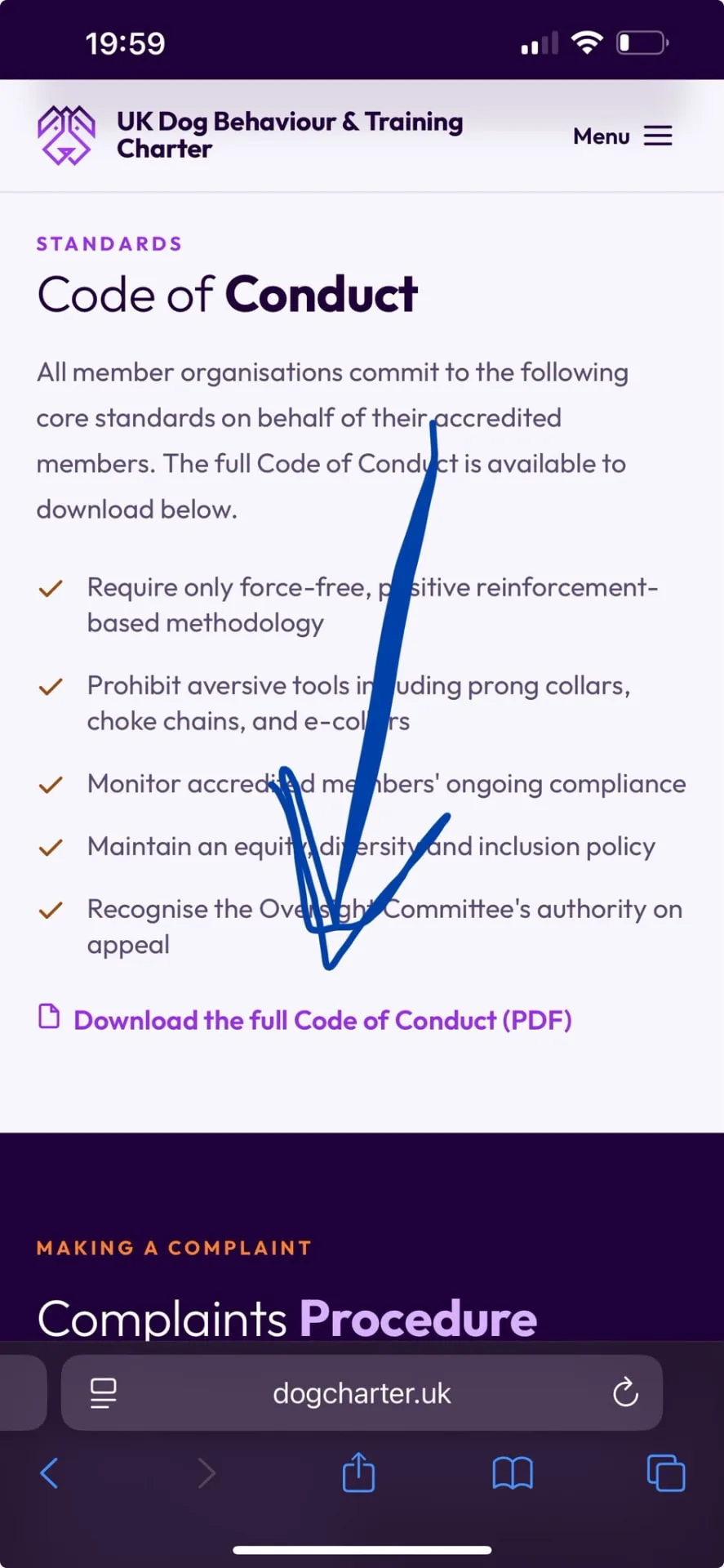
I understand what they are trying to say.
I am a reward based trainer. Dean is a reward based trainer. We are not deliberately inflicting pain on dogs or using fear as our primary way of producing behaviour. Any experienced reward based trainer reading those words can probably say, “Yeah, I know broadly what they mean.”
The problem is that “broadly” is nowhere near good enough if this language is intended to help shape regulation.
Take “No punishment based methods.”
If two puppies are playing and one becomes excessively rough, I might briefly remove access to the other puppy. If that loss of play reduces the rough behaviour in future, I have used negative punishment.
That is literally one of the four quadrants of operant conditioning.
It is also quite obviously not the same welfare proposition as taking a dog’s fucking head off with a prong collar.
The same problem exists with positive punishment. Even something as mundane as adding a verbal interrupter could, depending on its function, meet the behavioural definition of positive punishment if its consequence is a reduction in the behaviour. That does not suddenly make saying “no” ethically equivalent to deliberately causing pain or fear.
This is why the words matter.
If the intended rule is no deliberate use of pain or fear, write that. If it is no equipment designed primarily to deliver an aversive consequence, write that. If it is no intentional use of positive punishment above a defined welfare threshold, write that.
Those are all different standards.
“Force free” has exactly the same problem. Everyone in our part of dog training knows roughly what people mean by it. We use leads. We close gates. We put puppies behind barriers. We use harnesses. We physically prevent dogs reaching things that are dangerous. We restrain dogs when necessary for veterinary care. We manipulate access to environments and reinforcers constantly.
No sensible reward based trainer reads “force free” and thinks putting a puppy behind a baby gate breaches an ethical code.
But regulation cannot operate on “no sensible dog trainer would interpret it that way”.
The person interpreting the rule might not be a dog trainer.
They might be an investigator, a civil servant, a lawyer, an assessor or somebody sitting on a disciplinary panel five years from now. They may be looking at a complaint against a trainer they have never met and trying to decide whether that trainer has breached a professional standard.
And that leads to another problem with the Charter model as it currently appears to operate.
Ainsley told us directly that the member organisations remain responsible for their own members. The Charter website also says member organisations are expected to monitor their accredited members’ ongoing compliance.
So imagine somebody makes a complaint against an APDT trainer, an IMDT trainer, somebody from Victoria Stilwell Academy or another Charter organisation because they used a timeout and the complainant argues that this breached the Charter’s stated prohibition on punishment based methods.
What happens?
I would assume that most experienced organisations would look at that complaint and say, quite reasonably, that briefly removing access to play is not the kind of thing the ethical standard was intended to prohibit.
But then we immediately have a problem.
They are interpreting the wording rather than applying the wording.
If the Charter literally says “No punishment based methods”, and the organisation decides that some punishment procedures are obviously acceptable, then what exactly is the standard?
Alternatively, if an organisation followed the words completely literally, it could potentially find one of its own members in breach for using a completely ordinary reward based training procedure.
Neither outcome is particularly satisfying.
And there is something here that worries me more than the bad wording itself.
The Charter website lists organisations including the APDT, IMDT, Victoria Stilwell Academy, PPG, COAPE and others. These are not organisations that should be unfamiliar with operant conditioning.
They know what negative punishment means.
They know that punishment is a functional description in learning theory, not simply a synonym for being horrible to a dog.
So how did “No punishment based methods” survive the process?
I am not saying that as some sort of gotcha. I genuinely think it is an important question.
If a group of established dog training and behaviour organisations are collaborating around a minimum professional standard, surely one of the advantages should be that somebody around the table says, “Hang on, that sentence does not actually mean what we want it to mean.”
Maybe somebody has raised it. Maybe the detail is clarified in the full Code of Conduct.
I would happily read it.
Unfortunately, at the time of writing, neither Dean nor I can download the Code of Conduct from the Charter website. The link currently leads to a page that says the requested URL cannot be found. Ainsley herself pointed us towards the criteria when we challenged the wording, so I am assuming this is simply a broken link and nothing more sinister than that.

Websites break. It happens.
But fucking hell, in the context of this article it could hardly illustrate the problem better.
You have an organisation that explicitly wants to contribute towards eventual regulation of dog trainers. Its public summary contains terminology that is ambiguous when read through basic learning theory. The organisations signed up to it are responsible for policing their own members against those standards. When we ask for the detail that might clarify the ambiguity, the document cannot currently be accessed.
For an ordinary membership organisation, that is mostly an irritating website problem.
If you are positioning your framework as something that could help government regulate an entire profession, the bar has to be higher.
Because the wording is the job.
This is not me arguing that the Charter intends to prosecute somebody for putting a puppy behind a baby gate or using a thirty second timeout. I do not think that for a second.
The problem is exactly the opposite.
I know what they probably mean.
Dean knows what they probably mean.
Most experienced reward based trainers probably know what they mean.
A professional standard cannot depend on the word “probably”.
If there is any realistic possibility that somebody could intentionally, politically or simply ignorantly interpret a badly written standard in a way that affects whether another person can practise, retain professional recognition or earn their living, then the standard needs to be written so clearly that somebody with no background in dog training can understand what is permitted, what is prohibited and why.
You cannot rely on the person enforcing it being a dog trainer who knows what you meant.
And this is exactly why writing regulation is so fucking difficult.
The problem is not deciding that we want ethical dog training.
Almost everybody says they want that.
The problem is turning “ethical dog training” into words precise enough that thousands of professionals can be judged against them fairly.
The government taskforce itself acknowledges that attempts to create a unified system have struggled partly because the profession still disagrees about acceptable training methods and what professional competence should look like.
ABTC has moved further towards something formal through its work with UKAS. That matters, but I think it is easy to make the UKAS bit mean more than it does.
ABTC’s own announcement said its Assessing Organisations Certification Scheme had been recognised by UKAS as suitable for formal conformity assessment, allowing it to move towards applying for Certification Body status. The government report describes ABTC’s processes, but not the standards themselves, as having been accredited by UKAS.
That second part is the bit I care about.
External scrutiny of how people are assessed, how decisions are made and whether a certification process is consistent is obviously useful. But you can quality assure the absolute shit out of a process and still have legitimate arguments about what the process is measuring.
Who decided what practical competence looks like? Who decided where one professional role stops and another starts? Who decided which methods are acceptable? Who decided how education providers should demonstrate quality?
UKAS does not make those questions disappear.
Someone has to help write the rules, and I am bloody glad it is not me.
That does not mean we stop asking who handed them the pen.
What Happens When Voluntary Standards Become Everybody’s Standards?
This is probably the bit that matters most in the UK right now.
ABTC can set standards for people who voluntarily choose to work within its system. The Charter can do the same thing. If you want their badge, you accept their rules.
Government regulation is different because eventually you stop talking about people volunteering to join a system and start talking about rules that potentially apply to everybody.
The Responsible Dog Ownership Taskforce has not recommended simply handing the profession to ABTC. Its recommendation is to explore the options for regulating dog trainers and behaviourists and take forward the best option. The report also says further evidence gathering and wider consultation are needed.
That is important because we have spent years building voluntary organisations around people who broadly agree with each other. That is relatively easy compared with creating something that has to deal with the whole profession.
The second government starts turning one of those models into a national standard, the question changes.
What happens to experienced trainers who sit outside that system? What happens to somebody who has been working successfully for twenty years but does not hold one of the recognised qualifications? What happens to education providers whose courses do not fit neatly into the approved pathway? What happens to trainers whose methodology sits outside the ethical position of the organisation that helped write the framework?
I am not asking because I think everyone should automatically be grandfathered in and allowed to carry on exactly as they are. If somebody is unsafe, incompetent or causing unnecessary harm, I would hope regulation makes that harder.
I am asking because statutory regulation cannot simply behave like a membership club.
Singapore has already crossed some of these bridges. It has written minimum standards covering learning theory, practical competence, continuing education, scope of practice, record keeping, informed consent and LIMA.
You can agree with all of it, disagree with parts of it or think some of the thresholds are too weak.
At least the difficult decisions are visible.
The UK is not there yet.
And if regulation comes, I want the people writing it to hear from ABTC. I want them to hear from the Charter. I want academics, welfare scientists, experienced practical trainers, behaviourists, vets, educators and people who understand assessment involved.
I also want them to hear from people they fundamentally disagree with.
Otherwise consultation becomes a group of people who broadly hold the same position sitting around deciding how everybody else should work.
It cannot simply be about choosing whichever voluntary system has got furthest with the paperwork.
The question is whether the standards themselves are good enough to apply to everybody.
So Do I Think Dog Trainers Should Be Regulated?
When I started looking at this again, I thought the question was going to be whether regulation was a good idea.
I am increasingly convinced that is probably the least interesting question.
Of course I want dogs protected from people who have no idea what they are doing. Of course I want owners to have some way of knowing that the person they are paying has demonstrated a reasonable level of competence. I would also quite like a world where somebody cannot watch twelve TikToks, print some business cards and start charging people to deal with serious aggression the following morning.
The difficult bit is everything that comes after saying yes.
What counts as enough experience? What does practical competence actually look like? Competent to do what? Who decides where training becomes behaviour? Who decides which methods are acceptable? How do we stop a minimum standard becoming the maximum anybody bothers aiming for? Who decides which education providers count? Who checks the people making those decisions?
And what happens when they get it wrong?
I do not think those questions mean we should abandon regulation. If anything, Singapore has made me more interested in it because it has forced some of these conversations out of vague statements about professional standards and into actual rules that can be examined.
There is plenty in the Singapore code that I like. I like the emphasis on competence, ongoing development, working within your expertise, record keeping, informed consent and having some structure around welfare and training methods.
There are also parts I would question. One year of experience before somebody can supervise another trainer still feels incredibly weak to me, and words like practical proficiency and least intrusive become much less simple once you apply them to real dogs.
That does not mean I could write a better code tomorrow.
I absolutely fucking couldn’t.
I have spent most of this article pointing at problems, and somewhere there are people whose actual job is to find answers to them. I can ask why the threshold is one year. If they make it three, I can ask why it is three. If they replace years with an assessment, I can ask whether the assessment measures anything useful.
People like me must be an absolute pain in the arse when you are trying to write regulation.
But that is why I think these conversations need to happen before the rules are settled rather than afterwards.
The UK taskforce is still recommending evidence gathering and wider consultation before deciding what the regulatory model should be. That seems like exactly the point at which trainers and behaviourists should be asking awkward questions rather than assuming the outcome has already been decided.
I have written previously about Following the Paperwork: David Montgomery’s Regulation Blog Doesn’t Add Up, where I looked more closely at some of the organisations and relationships around the UK debate. I have also written about What Does “Accredited” Actually Mean in Dog Training?, because accreditation and competence are not automatically the same thing. And in Online Courses vs Hands-On Experience: The Blind Spots in Dog Trainer Education, I went much deeper into what I think actually develops good trainers.
This article probably leaves me with more questions than answers, and I am fine with that.
If regulation is going to affect who can work, how they can work, what education counts and potentially which methods they can use, I would rather we ask too many awkward questions now than discover five years later that we created a beautifully regulated system around the wrong fucking things.
That is where I am currently at.
What can you actually do about regulation?
Enter your email and we'll send you what you can do right now to have a voice before the rules are set.