What Equipment Do I Need to Be a Dog Trainer?
By Dean Nicholas
If you're thinking about becoming a dog trainer, you might be wondering what equipment you actually need to get started.
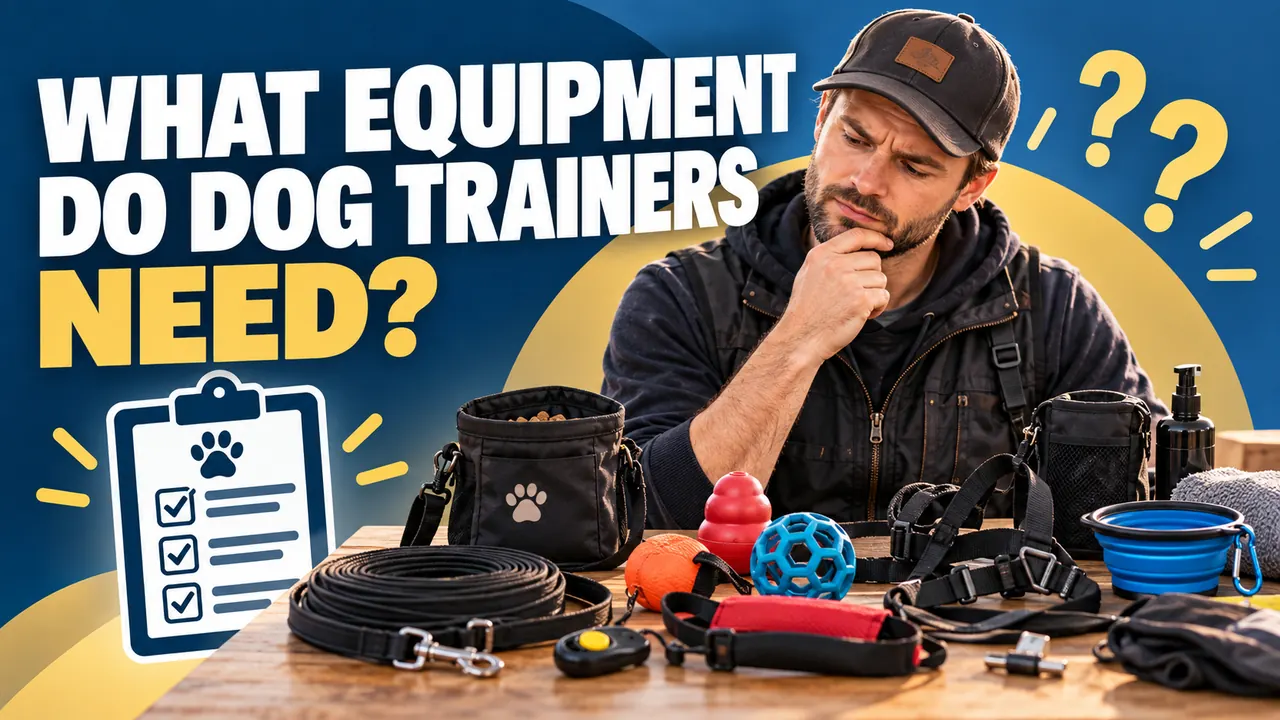
Do professional dog trainers need bags full of specialist equipment? Do you need to buy different leads, harnesses, training platforms, whistles, toys and gadgets before you can work with clients?
The good news is: No!
One of the great things about becoming a dog trainer is that the basic equipment needed to get started is relatively inexpensive.
A treat pouch, some good rewards, a lead, a long line, a clicker and a few toys will allow you to train an enormous range of behaviours and dogs.
Your knowledge, observation skills, timing and ability to change behaviour are far more important than the equipment you carry.
That said, there are some pieces of dog training equipment that we think virtually every aspiring trainer should own, alongside some additional items that can make life considerably easier as your training develops.
Let's take a look.
What Equipment Do Dog Trainers Need?
For most aspiring dog trainers, we would divide equipment into two categories:
Must-have dog training equipment
These are inexpensive items that we think almost every trainer will regularly use.
Nice-to-have dog training equipment
These can be extremely useful for particular training exercises or types of client, but you certainly don't need to buy them all before you start.
Let's begin with the essentials.
Essential Dog Trainer Equipment
1. A Treat Pouch
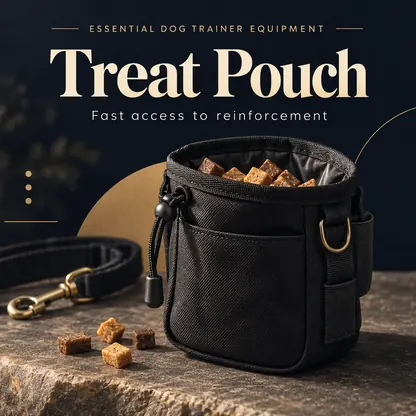
If there is one piece of equipment that you'll probably use more than almost anything else, it's a good treat pouch.
When using food as reinforcement, speed matters.
You don't want to mark a behaviour and then spend the next ten seconds searching through your coat pocket for a piece of chicken.
A treat pouch gives you quick and consistent access to reinforcement.
Look for something that:
• Is easy to open and close
• Allows you to quickly access food
• Can be cleaned easily
• Attaches securely to your clothing or belt
• Is large enough to carry plenty of rewards
Some trainers prefer traditional fabric bait bags, while others prefer washable silicone pouches.
My personal favourite can be found here, big enough for your hand, not too big to restrict movement.
2. A Clicker
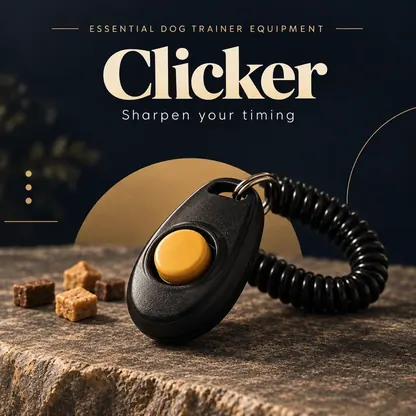
A clicker isn't compulsory for training dogs.
You can absolutely use a verbal marker such as "yes".
However, we think clickers are incredibly useful tools for aspiring trainers.
A clicker produces a short, consistent and distinctive sound that can be conditioned as a marker.
Learning to use one also encourages trainers to think carefully about one of the most important skills in dog training:
timing.
If you want to reinforce a specific behaviour, you need to be able to accurately identify the moment that behaviour occurs.
Clicker training is a great way of developing that skill.
Clickers are also inexpensive, so having a couple in your training bag is sensible.
To be honest I have them in the glove box, jacket pockets & training bags… but I am a little obsessed with precision.
I’d go for a pack like this to get you started.
3. A Standard Training Lead
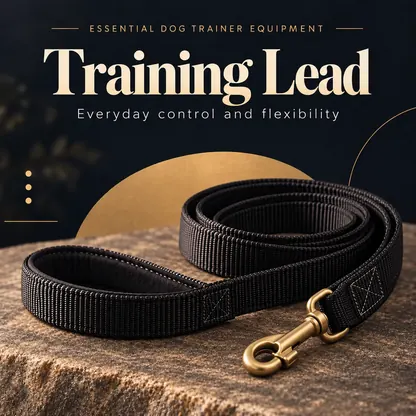
Dogs arriving for training sessions will usually have their own lead with any number of random contraptions attached to it.
However, it's still worth having a good-quality training lead available.
For general training, something around 1.5 to 2 metres long gives you considerably more flexibility than many short everyday dog leads and their fancy water bowl attachment. Keep it simple an strong here.
You want a lead that is:
• Comfortable to hold
• Strong enough for the dogs you're working with
• Easy to manipulate
• Long enough to allow some freedom of movement
You don't need a cupboard containing twenty different leads, find something YOU like handling.
One or two good-quality general-purpose leads will cover most situations.
My go to leads are fabric to they don’t slips and have clips for altering the length… like this one
4. A Long Line
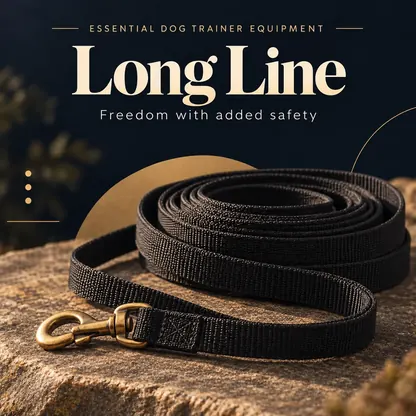
A long line is one of the most useful pieces of dog training equipment you can own.
It allows dogs to have considerably more freedom while maintaining an additional layer of safety.
Long lines are particularly useful when working on:
• Recall
• Engagement outdoors
• Distance behaviours
• Loose lead and off-lead preparation
• Training around distractions
• Sniffing and exploration
• Behaviour change in larger environments
For general dog training, 5 metre and 10 metre long lines are both useful options.
There is a skill to handling a long line safely, particularly around fast-moving dogs, so aspiring trainers should practise their mechanical skills rather than simply clipping one on and hoping for the best.
My preference… 10m and fabric because it wont slip through my hands. BUT… they do get heavy when wet.
5. Food Rewards

This might sound obvious, but trainers need rewards.
And importantly, not all food is equally reinforcing to every dog.
Dry kibble may work perfectly well in a low-distraction environment for one dog and be almost worthless to another dog outside.
It is useful to have several different reinforcement options available.
You might have:
• Regular dog treats
• Small soft training treats
• Higher-value meat-based treats
• The dog's normal food
• Particularly high-value food for difficult environments
What matters is not what you think should be rewarding.
What matters is what the dog is prepared to work for in that situation.
If you’re looking for a product link here – you’re going to be broke… don’t buy pre-made treats for the number of treats you are going to need. Cook chicken breast and chop it up small, or use cocktail sausages in a fix.
6. Tug Toys
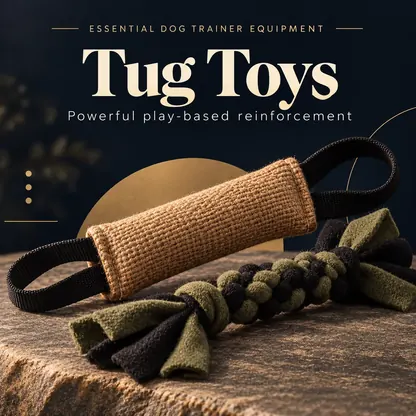
Dog trainers shouldn't assume that food is the only useful reward or reinforcer.
For some dogs, play can be extremely powerful (and in many cases far more salient to the dog)
A tug toy gives you an opportunity to develop your skills using rewards that behaves very differently from a piece of food and learning how to use arousal to your advantage.
Tug can be incorporated into ANY training, but certainly powerful for:
• Recall
• Engagement & Focus
• Impulse-control exercises
• Adding speed or power to a behaviour
It can also teach trainers really important lessons and skills
For tug toys, my preference will always be something with a clear handle for me and a clear part of the toy to bite. I have found furry and fluffy ends get a more immediate result.
Something like this…
But for breeds with more powerful bite or those that like to run off with the toy and pluck it, you might be better off with something a bit less on the fluffy / elasticated side… Like this…
7. A Ball on a Rope
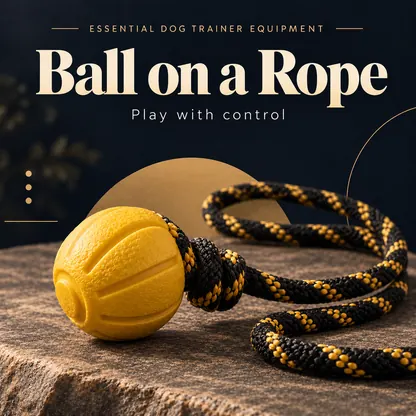
A ball on a rope is another useful option for dogs motivated by play.
The rope makes it easier to interact with the dog while maintaining possession of the toy and can provide more control than repeatedly throwing a loose tennis ball.
Again, you certainly don't need dozens of toys.
Having a small selection simply gives you different options when working with different dogs.
I would take this opportunity to tell you to NOT use a ball without a rope or handle when training other peoples dogs. The risk of choking is just too high in my opinion. So instead… go for something like this.
8. A Dog Whistle
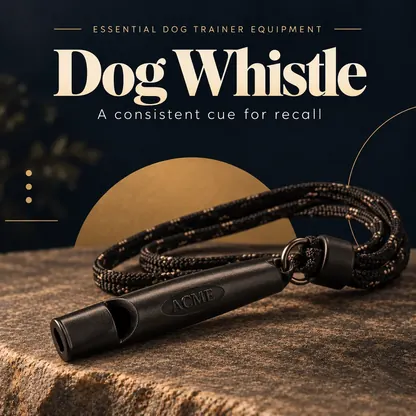
A whistle can be particularly useful for recall training.
Unlike a human voice, a whistle produces a relatively consistent cue.
One of the most recognisable options in the UK is the ACME dog whistle, although there are plenty of alternatives available.
You certainly don't need a whistle to train recall, but they're inexpensive, easy to carry and useful for aspiring trainers to understand.
Most importantly, you can train the whistle… and the owners can use it and sound the same.
I’ve always used the same one…
9. Poo Bags
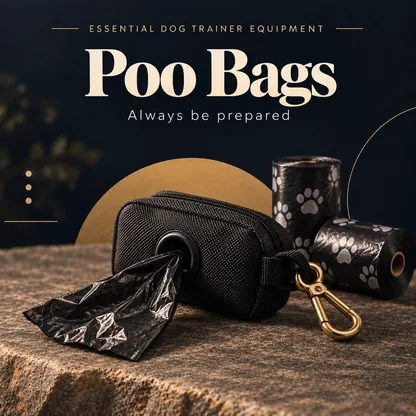
Perhaps not the most exciting addition to your professional dog training equipment list.
But definitely one of the most important.
If you're handling dogs during sessions or working in public areas, carry plenty of poo bags.
Keep some in:
• Your training bag
• Your treat pouch
• Your coat
• Your car
You will eventually be very grateful that you did…. Even on a cold day picking up dog poo with your hands is not desirable at all 😉
10. Water and a Collapsible Bowl
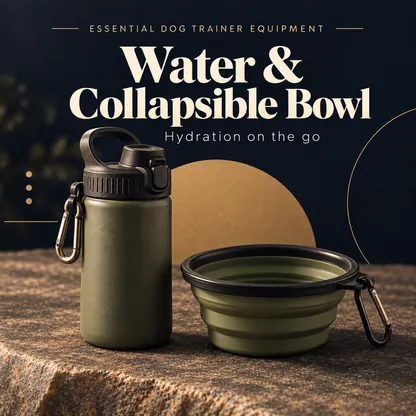
If you're running longer sessions, training outdoors or in high arousal, having drinking water available for the dogs is sensible.
Collapsible bowls take up very little space and can easily live permanently in your training bag or car.
This becomes particularly important during warmer weather.
Remember that training plans should always take the dog's physical comfort and environmental conditions into consideration.
Something like this will do the trick…
11. A Dog First Aid Kit
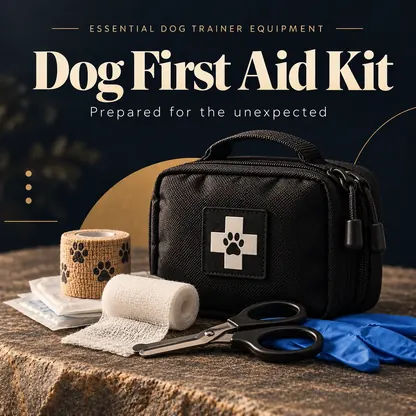
We'd strongly recommend dog trainers have access to a basic canine first aid kit.
Hopefully, you'll rarely need it.
But when you're professionally working around animals, it's sensible to be prepared for minor injuries and emergencies.
A first aid kit might contain things such as:
• Dressings
• Bandages
• Gauze
• Tape
• Scissors
• Disposable gloves
• Tick-removal tools
• Sterile wipes
Of course, owning a first aid kit isn't a substitute for knowing how to use it.
Taking a reputable canine first aid course is also worth considering if you plan to work professionally with dogs.
We did actually have Rachel Bean a Vet Nurse deliver an online canine first aid course which we are convinced has saved many dogs lives.
If its just the first aid kit you need, then something like this would do the trick…
12. Your Phone
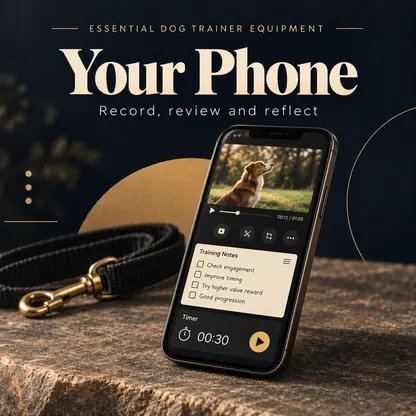
You probably already own this one.
Modern smartphones have become surprisingly useful pieces of dog training equipment.
You can use your phone for:
• Recording training sessions
• Reviewing your own training mechanics
• Showing clients demonstrations
• Recording client progress
• Setting timers
• Taking notes
• Running online consultations
• Accessing training plans and records
Video is particularly valuable.
Watching yourself train can expose things you simply don't notice while you're training.
You might discover that your reinforcement delivery is slow, your body position is influencing the dog, or you're accidentally giving a cue before you think you are.
Naturally, you should always obtain appropriate permission before filming clients or their dogs.
Nice-to-Have Equipment for Dog Trainers
Once you've got the basics, there are plenty of additional pieces of equipment that can make particular exercises easier or more fun.
None of these are compulsory.
• Target Stick
• Training Mat
• Training Cones
• Raised Training Platform
• Small Treat Pots
• Remote Treat Dispenser
• Phone Tripod
• Baby Gate or Portable Barrier
• Retrieve Dummies
• Snuffle Mats
• Lick Mats and Food Toys
• Portable Dog Crate
• Clipboard or Notebook
• A Head Torch
Equipment You Don't Necessarily Need to Buy
One mistake aspiring dog trainers can make is believing they need to own every piece of equipment a client might potentially use.
You don't.
For example, you don't necessarily need to immediately buy a collection of:
• Harnesses in every size
• Collars
• Muzzles
• Crates
• Dog beds
• Specialist leads
• Coats
• Grooming equipment
You should absolutely understand equipment that is relevant to your area of practice.
And if you're recommending something to clients, you should understand how it works, how it should be fitted and any relevant advantages or disadvantages.
But the dog's owner will normally supply most equipment that needs to be individually fitted to that dog.
There is little point in a new dog trainer spending hundreds or thousands of pounds building a mobile pet shop in the boot of their car…. Please don’t waste your money on this.
Do Dog Trainers Need Expensive Equipment?
No.
One of the most important things for aspiring trainers to understand is that expensive equipment does not create good dog training.
Imagine giving an inexperienced photographer a £10,000 camera.
Owning the camera doesn't suddenly give them an understanding of composition, lighting or photography.
Dog training is similar.
Owning a long line doesn't teach you how to handle one.
Owning a clicker doesn't give you good timing.
Owning a treat pouch doesn't teach you reinforcement placement.
Owning a tug doesn't teach you how to use play effectively.
The value isn't simply in the equipment.
It's in the knowledge and practical skill of the person using it.
What Should I Buy First If I Want to Become a Dog Trainer?
If you're starting from scratch, we would keep things simple.
Your first dog training kit could be:
1. A treat pouch
2. A clicker
3. A good 2 metre lead
4. A 10 metre long line
5. Food rewards
6. A tug toy
7. A ball on a rope
8. A whistle
9. Poo bags
10. A collapsible water bowl
11. A basic canine first aid kit
You probably already own the twelfth item:
a phone capable of recording video.
That's enough equipment to practise an enormous range of training skills.
Add specialist equipment later when there is a genuine reason to use it.
What Is More Important Than Dog Training Equipment?
This is perhaps the most important part of this article.
If you have £500 available to invest in becoming a dog trainer, we wouldn't suggest spending £500 filling a bag with dog training equipment.
Invest in your education.
Learn about:
• Operant conditioning
• Classical conditioning
• Reinforcement
• Punishment
• Extinction
• Stimulus control
• Reinforcement schedules
• Motivation
• Arousal
• Emotion
• Canine behaviour
• Ethology
• Learning theory
• Training mechanics
• Observation
• Client coaching
Then practise.
A lot.
The best dog trainers aren't necessarily the people with the fanciest equipment.
They're the people who can observe what is happening, understand why behaviour is changing and make good training decisions based on the individual animal in front of them.
Want to Become a Dog Trainer?
If you're researching what equipment dog trainers need because you're considering turning your interest in dogs into a career, equipment is only one tiny piece of the puzzle.
You need an understanding of how dogs learn, how behaviour works and how to apply that knowledge practically.
At the School of Canine Science, we've taught thousands of dog trainers and dog owners around the world about the science behind training and behaviour.
You can explore our range of dog training and canine science courses to start building the knowledge you'll need to work with dogs professionally.
If you’re just starting out, check out the 30 Days of Canine Science or our world renowned Puppy Lab.
Because ultimately, the most important piece of equipment a dog trainer has isn't in their training bag.
It's the knowledge they bring with them.