Are Dogs Really Talking to Us? The Science Behind Those Button Videos
By Nando Brown
I remember speaking at an IMDT conference, I think around 2015 or 2016, and sharing an idea I'd been thinking about. I wanted to see whether we could give dogs more of a say in their own training, specifically by allowing them to choose what they wanted to do and what they wanted to work for.
Listen to this article · read by Nando Brown
My idea was fairly simple. We could teach a dog to indicate different signs or symbols, each representing an activity. For example, I might offer one of my dogs the choice between scent work and bite work, and whichever one they indicated was what we'd go off and do. We could then take it a little further and ask what they'd like to work for. Did they fancy food or toys? If they chose toys, would they prefer a ball or a tug?
Obviously, we'd need to teach them what each symbol represented and make sure their selections reflected what they actually wanted. But I was interested in whether we could develop a system that allowed dogs to express preferences about their training, rather than always having us make those decisions for them.
As dog trainers, we spend an enormous amount of time trying to work out what our dogs find reinforcing. We test different foods, experiment with toys, watch their behaviour and build up a picture of what they enjoy. I wondered whether we could give them another way of telling us, particularly if we were prepared to respect the choices they made. After all, there's not much point asking a dog what it wants to do if you're going to ignore the answer because you've already decided it's a tracking day.
I was rather pleased with the idea at the time, although I've since discovered that I was considerably less original than I thought. While researching the dogs that have become famous for apparently talking to their owners through recorded speech buttons, I came across some work that predates my conference presentation by quite a few years.
In 2008, Alexandre Rossi and César Ades published research describing a dog called Sofia who had learned to use a keyboard with symbols to request different objects and activities. Further research in 2012 explored Sofia's ability to respond to spoken instructions involving combinations of objects and actions. The experiments weren't identical to what I'd been proposing, but they were certainly investigating closely related ideas.
So, while I was standing on a stage thinking I'd come up with something rather clever, researchers in Brazil had already been exploring similar territory years earlier.
I suppose that's something we're all guilty of occasionally, and it happens quite a bit in dog training. Somebody comes across a technique or an idea, starts experimenting with it and genuinely believes they've discovered something new. Sometimes they have, but quite often it turns out that somebody else has already done it, perhaps under a different name or in a completely different field. There's nothing particularly wrong with arriving at an idea independently. It's just worth remembering that discovering something for ourselves isn't necessarily the same as discovering it for the first time.
Anyway, my original idea was relatively straightforward. What I hadn't anticipated was just how far some people would eventually take it.
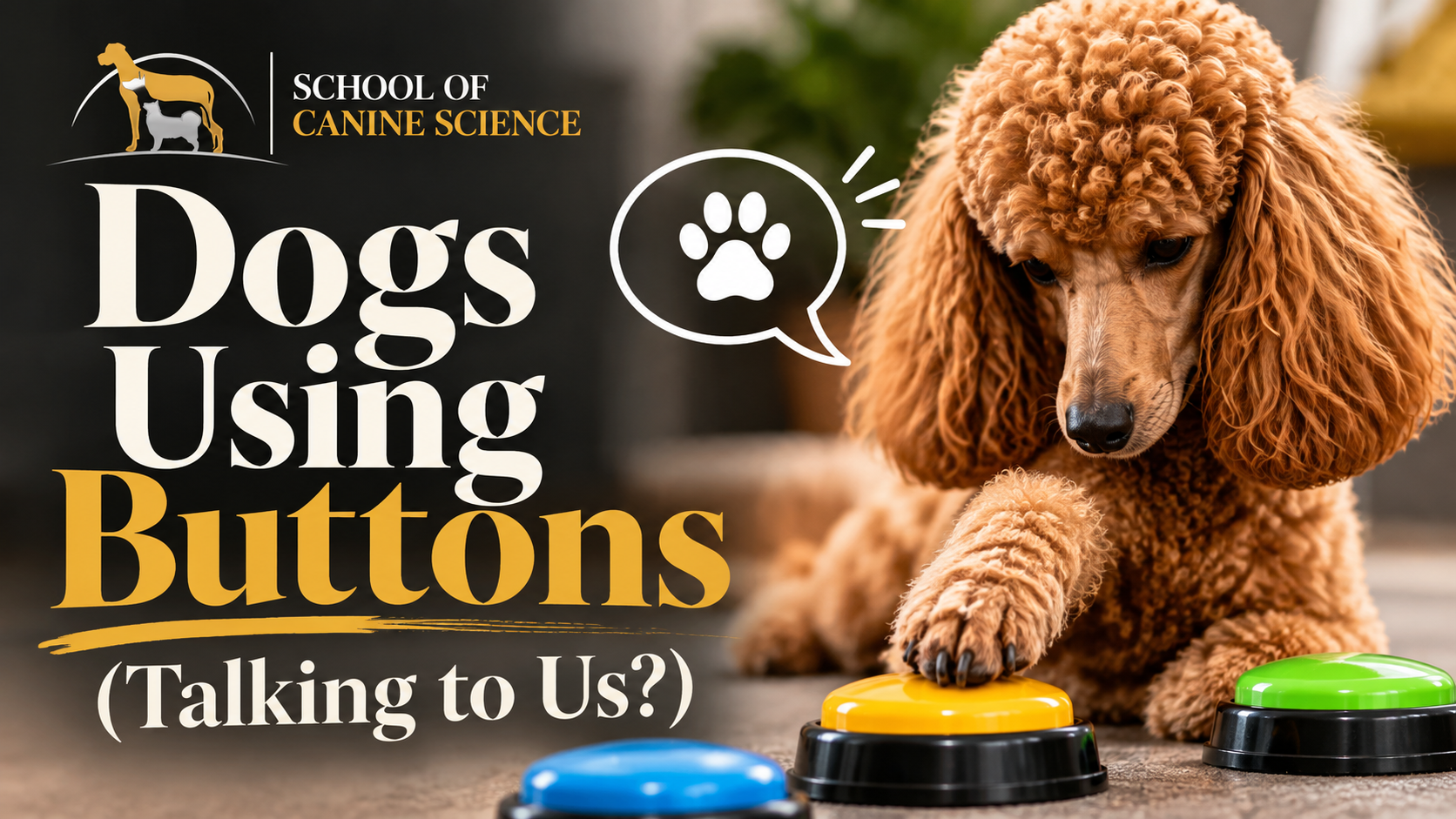
If you've spent any time on Instagram or TikTok, you've probably come across videos of dogs using soundboards fitted with buttons that play recorded words. Some of these dogs have enormous followings, and their owners interpret the button presses as everything from simple requests to surprisingly complicated conversations. There are dogs apparently asking questions, talking about their emotions, referring to past events and, in some cases, making statements that people have interpreted as evidence of self-awareness.
I've watched quite a few of these videos now, and I can understand why people find them fascinating. Some of the interactions are genuinely impressive, particularly when a dog appears to use several buttons together in a way that makes sense in the context of what's happening. But I've also found myself wondering how much of the meaning is coming from the dog and how much is being supplied by the person watching it.
Anyone who's lived with a dog that brings them a lead when it's time for a walk knows that communication doesn't require spoken language. Teaching that same dog to press a button that says "outside" might give it another way to communicate, but it doesn't necessarily tell us anything extraordinary about its understanding of language. What happens when we move beyond those relatively straightforward requests is where things become more interesting.
Fortunately, we're no longer relying entirely on social media videos and their owners' interpretations. There's published scientific research investigating how dogs learn these associations, whether they recognise recorded words and what happens when they start pressing several buttons together. Some of the findings are encouraging. Others raise questions that don't tend to receive quite as much attention online.
And coming back to my original idea, I'm particularly interested in whether any of this could be practically useful. If we can give dogs more opportunities to make choices about their activities, their environment or their training, there could be some genuine welfare benefits. So I've been looking into the history, the dogs behind the most popular accounts and the scientific evidence to see what we actually know.
The Dogs Who Were Doing This Long Before TikTok
The more I read about Sofia, the more I realised how much work had already gone into investigating these questions. She was a mixed-breed dog who lived with one of the researchers and participated in a long-term research programme at the University of São Paulo in Brazil. Her training began when she was a puppy, and by the time the keyboard research appeared in Animal Cognition in 2008, she'd already spent considerable time learning to use a symbolic communication system.
The keyboard had a series of keys marked with arbitrary symbols, which Sofia learned to associate with things she could request, including food, water, walks, toys, affection and going to her crate. These weren't pictures of the things she wanted. The symbols were deliberately arbitrary, so Sofia had to learn what each one represented. That might sound rather familiar to anyone watching the modern talking-dog videos, although Sofia wasn't being presented as a dog having conversations about the meaning of life.
What made the research interesting was how she used the keyboard once she'd learned the associations. The researchers observed Sofia approaching the keyboard and pressing particular keys when the corresponding activities or objects were relevant. They also found that she tended to look towards the experimenter more frequently after pressing a key than beforehand.
That's useful information because it suggests she was doing more than simply operating the equipment. Her behaviour was consistent with directing a request towards another individual and anticipating a response. In their 2008 paper, Alexandre Rossi and César Ades interpreted Sofia's behaviour as intentional communication through arbitrary signs.
Now, we're talking about one intensively trained dog, so we need to be careful about generalising those findings. But the researchers had demonstrated that a dog could learn to use a symbolic system to request things from people, and that's pretty close to the sort of application I'd originally been considering.
The team also investigated Sofia's ability to understand spoken instructions. In a 2012 study, Daniela Ramos and César Ades explored whether Sofia could respond to instructions combining information about an object with information about an action. She was taught words referring to objects, including a ball, key, stick, bottle and bear, alongside actions such as fetching and pointing.
The researchers then started combining those words. For example, could Sofia respond appropriately when asked to fetch a particular object and point to another, including combinations that hadn't previously been trained together? She demonstrated that she could.
For dog trainers, there's a useful distinction here. If I've taught a dog to retrieve a ball and retrieve a tug, I haven't necessarily demonstrated that it understands the separate meanings of "retrieve", "ball" and "tug". It might simply have learned two complete cues. But if I can recombine familiar words and the dog responds appropriately, that starts giving us additional information about what it's learned.
Sofia's performance suggested she could use information from the separate components of an instruction rather than relying entirely on memorised combinations. That doesn't establish human-like grammar, and the researchers weren't claiming it did. They were investigating a much narrower ability involving a limited vocabulary of familiar objects and actions. It's also worth remembering that this particular experiment involved Sofia responding to instructions given by people. That's different from a dog producing combinations of symbols to communicate something of its own.
Sofia wasn't the only dog contributing to this area of research. In 2004, Juliane Kaminski and colleagues published a study in Science involving Rico, a Border Collie who had learned the names of more than 200 objects.
Rico could retrieve familiar objects when asked for them by name, but the researchers were particularly interested in what happened when they introduced unfamiliar words. When presented with several familiar objects and one unfamiliar object, Rico could often infer that the new word referred to the object whose name he didn't already know. He also demonstrated some retention of those associations when tested several weeks later.
The researchers discussed this in relation to fast mapping, a term used in research on children's word learning. Whether Rico was using exactly the same underlying mechanisms as children has been debated, but the results demonstrated some impressive learning and memory abilities.
Then there was Chaser, another Border Collie, whose work with psychologist John Pilley received considerable attention. I won't go into too much detail because we cover Chaser in depth during the Behaviour Bible.
In a 2011 paper published in Behavioural Processes, Pilley and Alliston Reid reported that Chaser had learned and retained the individual names of 1,022 objects following several years of intensive training. She could also distinguish between individual object names and broader categories such as balls and toys.
Now, I appreciate that most of us aren't about to spend three years teaching a dog the names of more than a thousand toys, particularly when half of us struggle to remember where we've left the bloody leads. But these studies show that at least some dogs can learn considerably more about human verbal labels than we might ordinarily expect from everyday obedience training.
There's an important difference between these abilities, though. Rico and Chaser were primarily being studied for their understanding of human words. Sofia's keyboard experiments were investigating whether a dog could produce an arbitrary signal to communicate a request. Understanding a word and choosing to use a symbol are related abilities, but we shouldn't assume that demonstrating one automatically establishes the other.
And that's particularly relevant when we start looking at the modern soundboard dogs, because some of the claims being made about them go considerably further.
How the Talking-Dog Phenomenon Took Off
Although researchers had been exploring symbolic communication with dogs for years, the recent popularity of speech buttons can largely be traced to Christina Hunger, an American speech-language pathologist, and her dog Stella.
When Hunger brought Stella home as a puppy in 2018, she was working with children who had difficulties communicating through speech. Part of her professional work involved augmentative and alternative communication, usually shortened to AAC. These are systems that allow people to communicate using methods other than, or alongside, spoken language. They might involve gestures, picture boards or electronic devices that produce recorded speech.
Hunger noticed similarities between some of Stella's natural communication behaviours and those she observed in young children before they developed spoken language. Stella would look towards things she wanted, vocalise or use her body language to attract attention. Hunger wondered whether she could adapt some of the methods she used professionally to give Stella another way of communicating.
She started with a handful of recordable buttons programmed with words such as "outside", "play", "water" and "walk". Her approach was based largely on modelling. Whenever she took Stella outside, for example, she'd press the corresponding button, say the word and then carry out the activity. The same process was repeated with other words during ordinary daily routines.
According to Hunger, it took several weeks before Stella began using the buttons independently. When Stella pressed "outside", Hunger would respond by letting her out. The activity itself provided the consequence, rather than Hunger handing over food treats for pressing the correct button.
From a dog-training perspective, we can understand how those associations might develop. If pressing a particular button repeatedly results in access to something the dog wants, that behaviour has a perfectly good reason to occur again.
Hunger gradually introduced more words, and the buttons were eventually arranged together on a board. As Stella became more experienced, Hunger added words referring to people, locations, actions and more abstract concepts. By November 2019, Stella was attracting international attention, with reports describing her use of 29 buttons and Hunger's claims that she could combine several words into phrases.
Hunger went on to publish How Stella Learned to Talk in 2021, documenting Stella's training and development. On the Hunger for Words website, she describes Stella using more than 50 words, combining them into phrases and apparently communicating thoughts, feelings and observations.
Those are considerably more ambitious claims than requesting access to the garden. It's also worth remembering that the equipment originally adapted by Hunger was developed to support human communication. A person using a speech-generating device may already understand language perfectly well but be unable to express themselves through ordinary speech. We can't assume a dog using similar equipment has the same underlying understanding simply because the device produces recognisable human words.
Nevertheless, Hunger's work caught people's imaginations, and other owners began experimenting with the same approach. Among them was Alexis Devine, who started teaching her Sheepadoodle, Bunny, to use recorded speech buttons after seeing Stella's progress.
Commercial products also made the systems easier to obtain and expand. Companies such as FluentPet developed recordable buttons arranged on interlocking tiles, allowing owners to build increasingly large soundboards. Before long, people were watching dogs apparently using dozens of words, combining buttons and producing exchanges that sounded remarkably like conversations.
And, of course, social media is very good at taking something interesting and making it look extraordinary. A dog pressing "outside" before going into the garden might attract some attention. A dog apparently asking whether it's a dog, telling its owner it's sad or discussing something that happened yesterday is much more likely to get people talking.
The Dogs Behind the Viral Videos
If there's one dog responsible for taking this phenomenon to another level, it's probably Bunny, the Sheepadoodle belonging to Alexis Devine. You can find her on Instagram and TikTok under @whataboutbunny, where she's attracted millions of followers.
Bunny reportedly uses more than 100 recorded words. Some of her videos involve fairly straightforward requests, while others have left people wondering whether dogs might understand concepts we've never seriously considered them capable of communicating.
One particularly famous example appeared in 2021, when Bunny pressed four buttons in succession: "dog", "what", "dog" and "is". In another video, Bunny pressed buttons corresponding to "who" and "this" in an interaction involving her reflection in a mirror.
These exchanges were widely interpreted as Bunny questioning what a dog was, or perhaps even beginning to recognise herself as an individual. You can understand why people found that fascinating. If a dog is genuinely asking questions about its own identity, we're dealing with something considerably more complicated than requesting dinner. The internet, predictably, went a bit mad.
But there's quite a difference between observing Bunny press those buttons and establishing that she intended the abstract questions people constructed from them. The sequence might reflect meaningful associations with particular words. It might also involve combinations whose significance is being supplied by the person interpreting them. The videos are interesting observations, but they don't allow us to distinguish those explanations confidently.
There's another Bunny interaction that I find particularly interesting because the reported outcome was something much more concrete. In a widely circulated video, Bunny pressed "mad" and "ouch". Devine asked where she was hurting, and Bunny then pressed "stranger" and "paw". When Devine examined Bunny's foot, she found a foxtail lodged between her toes.
Devine explained that she hadn't specifically taught Bunny to use "stranger" to mean a foreign object, and interpreted the sequence as Bunny using a familiar word in a new context to communicate that something was hurting her paw. The interaction is included in the PBS NOVA documentary Can Dogs Talk?, where you can see the sequence and Devine's responses.
Now, that's interesting. If Bunny was genuinely using those buttons to communicate that something foreign was hurting her paw, it would be a potentially valuable ability. Particularly if she was reporting information that wasn't otherwise obvious to the person caring for her.
There are still questions about the interpretation and how the exchange unfolded, including prompts from Devine during the interaction. But it's precisely the sort of example I'd like to see investigated under more controlled conditions.
Christina Hunger's dog Stella has also appeared in videos involving apparent emotional statements. One example on the Hunger for Words website is titled "Why is Stella mad?"
According to Hunger, Stella appeared upset one morning, so she asked what was wrong. Stella pressed "mad" and barked. Hunger then asked why she was mad, and Stella pressed "Stella", followed by "eat" three times. Hunger explained that her normal routine had changed and Stella hadn't received the morning snack she would usually have been given. After receiving food, Stella settled down.
Hunger interpreted this as Stella communicating both her emotional state and the reason for it. Perhaps she was. It's also possible Stella was making a request for food, using buttons and behaviours that had previously been effective in obtaining it. Hunger's knowledge of Stella's routine helped her make sense of the interaction, but the video doesn't independently establish that Stella understood "mad" as a label for her emotional experience.
Another account worth examining belongs to Copper, a Labrador featured on @thechattylab. Copper's interactions were discussed in a 2024 paper published in Animals, which questioned some of the interpretations surrounding the talking-dog phenomenon.
One video involved Copper's swimming pool, which was apparently broken. Her owner asked what she wanted, and Copper pressed "pool". The owner explained that the pool was broken and apologised. Later in the interaction, when playing was suggested as an alternative, Copper pressed "mad" and turned her head away.
The video presents this as Copper expressing frustration because she couldn't use the pool. And perhaps she was frustrated. If she enjoys swimming and couldn't access an activity she normally finds reinforcing, frustration would be a perfectly plausible response.
But the researchers pointed out that much of the meaning depended on the owner's explanation. Without that commentary, we'd have a dog pressing "pool" and later "mad". The connection between those buttons and the broken pool comes largely from information supplied by the human.
That doesn't automatically make the interpretation wrong. People who live with dogs know an enormous amount about their individual routines and behaviour, and we routinely use that knowledge to understand what our dogs want. It does make it difficult for somebody watching a short video to establish independently what the dog intended.
There's another dog I'd like to mention because her reported use of these buttons takes us back towards the practical application that first interested me. Puppy Parker Posey is a Beagle cross belonging to Sascha Crasnow, who reports that Parker uses a board containing more than 120 buttons.
Parker appeared in the 2026 PBS NOVA documentary Can Dogs Talk?, and Crasnow has also spoken about using buttons to give Parker choices concerning her food. For example, Parker can indicate different ways she'd like her food presented, such as in a puzzle feeder or a snuffle mat.
According to Crasnow, there are occasions when Parker doesn't want to eat food presented one way but will happily eat exactly the same food when it's offered through a different activity. I find that quite interesting because the potential preference concerns the activity associated with eating, rather than simply the food itself.
We'd still need to investigate whether Parker's button selections reliably predict those preferences, but at least we've got something we could examine through observable behaviour. And unlike asking whether a dog understands sadness, we have established methods for investigating which activities and reinforcers dogs prefer.
Looking across these accounts, there's a considerable range of abilities being claimed. A dog learning to request an activity is one thing. A dog indicating a preference between activities is another. A dog communicating previously unknown information about an injury would be rather more interesting, while a dog genuinely questioning its own identity would be an extraordinary discovery.
I don't think we should treat all those claims as though they're equivalent. And the most ambitious ones raise a question that I kept coming back to while watching the videos.
But How Do You Teach a Dog What 'Sad' Means?
I can understand how a dog might learn to press a button to request a walk or a particular toy. We've got a fairly straightforward relationship between the behaviour and what happens afterwards, and we can arrange the training accordingly.
But what happens when we introduce words such as "sad", "mad" or "ouch"? If we're using a similar approach, what's the functional reinforcer for pressing "ouch"? We obviously aren't going to hurt the dog to demonstrate what the word means. And if we're teaching "sad", presumably we aren't planning to make the dog miserable every time it presses the button.
At least, I bloody hope not.
I wanted to understand how the people teaching these systems were approaching that problem, so I went looking for an explanation. In a 2021 interview with DogTime, Alexis Devine was asked almost exactly this question.
She explained that she would never deliberately cause Bunny pain and had instead modelled "ouch" during naturally occurring situations where either she or Bunny was injured. Devine described pressing the button when she'd been having tattoo work done and allowing Bunny to investigate the affected area. She also used it following Bunny's spay surgery and after Bunny injured her paw on barnacles at the beach.
For emotional words, she described something similar. If Bunny appeared upset, Devine would press "mad". She would also model the word when she herself was upset, hoping Bunny would develop an association.
That's a reasonable attempt to teach through context, and it's worth remembering that learning doesn't require us to arrange a particular functional reinforcer for every association a dog develops. But it leaves us with an interesting problem. What exactly is the dog learning?
When Devine presses "ouch" following an injury, Bunny has access to all sorts of information. There might be a visible wound, an unusual smell, changes in how somebody moves or attention being given to the injured area. It's entirely possible that Bunny could develop useful associations between the recorded word and those circumstances.
But how do we establish that she understands the subjective experience of pain itself? Even if Bunny later presses "ouch" when she's injured, we still have to consider whether she's communicating discomfort, responding to familiar contextual cues or using a button that has previously produced attention. Those explanations might overlap.
And it becomes even more complicated with emotions.
Imagine I observe a dog barking, pacing and repeatedly trying to access something it wants. I interpret that behaviour as frustration, so I model the word "mad". Perhaps I do that repeatedly over several weeks, and eventually the dog starts pressing "mad" in similar circumstances.
Have I taught the dog to describe frustration, or have I taught it to associate a particular sound with situations and behaviours that I interpret as frustration? The problem is that I'm the person deciding what the dog feels in the first place. If I then use its button pressing as evidence that my original interpretation was correct, I'm in danger of going round in circles.
This isn't an argument against dogs experiencing emotions. The difficulty is establishing whether a particular recorded word represents the dog's understanding of its internal state.
There's actually a revealing moment in that same interview with Devine. While she was explaining how she taught emotional words, Bunny interrupted by pressing "mad" and "potty".
Devine acknowledged that Bunny might not need the toilet at all. She suggested that Bunny had learned that pressing toilet-related buttons was an effective way of interrupting an interview and getting her attention. I rather liked that admission because it illustrates how complicated the interpretation can become once a dog has an extensive learning history with the buttons.
Bunny might have been communicating a desire for attention, while the literal meaning of the recorded word had very little to do with what she wanted.
And this brings me to an animal that anyone who's studied behavioural science will probably recognise. In the early 1900s, a horse called Clever Hans became famous in Germany for his apparent mathematical abilities.
His owner, Wilhelm von Osten, could ask him arithmetic questions and Hans would tap his hoof to indicate the answer. He was remarkably successful, and the performances attracted enough attention that a commission was established to investigate whether somebody was cheating. Initially, investigators found no evidence that anyone was deliberately signalling the answers.
It was psychologist Oskar Pfungst who eventually established what was happening. When the questioner knew the correct answer and Hans could see them, the horse frequently answered correctly. But when the person asking the question didn't know the answer, or Hans couldn't see them properly, his performance deteriorated dramatically.
Pfungst discovered that Hans was responding to tiny, unconscious changes in human posture and behaviour. As he approached the correct number of hoof taps, the person watching would make subtle movements that effectively signalled when he should stop. The people involved generally had no idea they were providing those cues.
I find Clever Hans fascinating because what he was actually doing was pretty impressive. He'd learned to detect extraordinarily subtle information from people and use it to guide his behaviour. He just wasn't doing the arithmetic everyone thought he was. You can read Pfungst's original investigation, which is well worth revisiting if you work with animals.
I'm not suggesting Bunny, Stella or the other button-using dogs are simply modern versions of Clever Hans. We'd need evidence for that explanation too. But there are two problems worth considering.
The first is unconscious cueing. Dogs are exceptionally good at responding to human behaviour, and as trainers we know how easily we can influence what an animal does without intending to. Where we're standing, what we're looking at and how we move can all become useful information for the dog.
If an owner asks a dog where something hurts while looking towards a particular part of the soundboard, for example, could that affect which button it presses? Possibly. And unless the experiment accounts for that, we can't confidently rule it out.
The second problem doesn't necessarily involve the dog being cued at all. Think back to Copper pressing "pool" and later "mad". Her owner knew the pool was broken and interpreted the interaction as frustration about not being able to swim.
That might have been precisely what Copper meant. But if we watched the same button presses without that information, would we reach the same conclusion?
We can construct a perfectly plausible explanation from a couple of words and our knowledge of the dog's circumstances. Then somebody watches the edited video, hears our explanation and perceives the exchange as a coherent conversation. The 2024 Animals paper explores these concerns, including how human interpretations and social media presentation might influence what viewers believe they're seeing.
We also rarely see every button press a dog makes throughout the day. If a dog produces twenty combinations that make little sense and one that sounds like a remarkably thoughtful statement, which one is more likely to end up on Instagram?
That doesn't mean anybody is deliberately misleading their audience. It means we need the unsuccessful interactions as well as the impressive ones before we can judge how reliable the apparent communication really is. Fortunately, researchers have begun testing some of these abilities under controlled conditions, which gives us something considerably more useful than arguing over individual videos.
What Does the Science Actually Tell Us?
In August 2024, Amalia Bastos and her colleagues published a study in PLOS ONE investigating whether dogs trained to use soundboards could recognise and respond appropriately to the words recorded on their buttons.
They weren't asking dogs to construct sentences or describe their feelings. They wanted to establish something more basic: when a dog hears a recorded word, does it respond as though it understands what that word refers to?
The researchers recruited 59 dogs already using soundboards at home. Thirty participated in experiments conducted by researchers, while another 29 took part in a separate experiment carried out by their owners using instructions supplied by the research team. The dogs were tested using familiar words associated with going outside, playing and food.
The predictions were fairly straightforward. A dog hearing "outside" might approach or look towards the door, while hearing "play" might produce behaviour directed towards toys. Of course, an owner might inadvertently influence those responses, which brings us back to Clever Hans. The researchers had thought about that.
In the researcher-led experiment, the buttons were covered with coloured labels so the unfamiliar researcher pressing them couldn't identify which word each button represented. The owner remained in the room but wore a sleep mask and noise-cancelling headphones, preventing them from seeing or hearing which word was presented. The researcher pressed the button, stepped away and remained still while the dog's behaviour was recorded for the following minute.
In the owner-led experiment, words were presented either through buttons or ordinary speech, and owners were instructed not to interact with their dogs during the observation period. The videos were then assessed by observers who didn't know which word had been presented.
I rather like this experimental arrangement because it makes a genuine attempt to remove some of the obvious opportunities for human interference. And the results were encouraging.
Dogs were more likely to display play-related behaviours after hearing play-related words and outside-related behaviours after hearing words associated with going outside. The statistical models estimated that the odds of those relevant behaviours were approximately seven times greater in their corresponding conditions than the average across the three familiar-word conditions.
That's a substantial effect, although we're talking about estimated odds of particular behaviours occurring, not seven times as many dogs understanding the words.
The food-related condition was less convincing. The researchers didn't find reliable evidence that food-related words produced more food-directed behaviour.
Now, as trainers, I suspect quite a few of us could come up with possible explanations. Perhaps the dogs had already eaten, or perhaps they didn't expect food outside their usual mealtimes. The researchers suggested similar possibilities, but we don't know which explanation, if any, is correct. The experiment simply didn't demonstrate the same effect for food.
They also found no clear difference between responses to recorded and directly spoken words, or between the researcher-led and owner-led conditions. So we've got evidence that these dogs could recognise at least some recorded words without relying on their owner's usual accompanying behaviour.
From a training perspective, it's not particularly surprising that dogs can learn associations between sounds and activities. But demonstrating those associations under controlled conditions, with dogs trained by ordinary owners, is useful. What the study doesn't demonstrate is that those dogs can use the same words to express their own thoughts or requests.
That brings us to another paper. In December 2024, Bastos and colleagues published a study in Scientific Reports examining patterns in the buttons dogs were pressing themselves.
This time the researchers analysed a much larger dataset: 194,901 reported soundboard interactions from 152 dogs over a period of 21 months, alongside 65,682 interactions in which owners pressed buttons to model their use. Around 29% of the dogs' reported interactions involved multiple buttons.
That's a lot of button pressing, although the way the data was collected matters. The researchers weren't continuously filming every dog and independently recording everything it did. Owners were logging their dogs' button presses through a mobile application, either when they happened or afterwards using recordings.
They were instructed to report everything, but the researchers couldn't independently establish whether every interaction had been included. The analysis also focused on dogs with at least 200 reported interactions, rather than representing every dog that had ever been introduced to a soundboard.
The researchers wanted to establish whether the dogs were pressing buttons randomly, whether certain combinations appeared more frequently than expected and whether the dogs were simply copying the buttons their owners tended to use.
They found that the patterns weren't adequately explained by random pressing. Some combinations occurred more frequently than expected, even after accounting for the fact that certain buttons were used considerably more often than others.
For example, combinations involving food and play appeared more frequently than their statistical models predicted. There were also patterns involving concepts such as going outside and requesting help. Interestingly, there was only a very small relationship between how often owners modelled particular button concepts and how often their dogs pressed them.
That suggests the dogs weren't simply repeating their owners' most frequently modelled buttons. And because the dogs had different soundboard arrangements, the researchers also investigated whether the patterns could be explained by accidentally pressing neighbouring buttons. Their results weren't adequately explained by that simple account either.
I think that's interesting. However, there's something about this study that deserves particular attention.
The researchers weren't investigating whether the dogs could construct grammatically meaningful sentences. When analysing combinations, they actually disregarded the order in which buttons were pressed. So "food" followed by "outside" was treated as equivalent to "outside" followed by "food".
Longer sequences were also broken down into neighbouring pairs for analysis. That approach was reasonable for investigating which concepts tended to occur together, but it means the study cannot tell us whether dogs understand word order or are constructing sentences according to grammatical rules.
And a reliable combination isn't necessarily evidence that the dog intends a new meaning. Imagine a dog that has learned pressing "play" gets attention and pressing "food" gets attention. Through its learning history, it might discover that pressing those buttons together produces a particularly enthusiastic response.
We could end up with a consistent, non-random combination without knowing what the dog intended to communicate. That's an alternative explanation, not something this study demonstrated, but it's one we'd want to investigate.
There's also the question of how complete the owner-recorded data was. If your dog presses "love you" followed by its own name, you're probably going to find that pretty memorable. If it presses "potty", "ball", "water" and "stranger" while walking across the board, perhaps you don't consider it quite so noteworthy.
The researchers acknowledged the possibility that owners might be more likely to record interactions they considered interesting. That doesn't invalidate the results, and the researchers argued that such biases were less likely to explain the patterns observed across many different households. Nevertheless, without a complete independent record, some uncertainty remains.
There was also considerable variation between individual dogs. Some showed highly consistent patterns, while others were much closer to what the researchers' chance models predicted.
For me, the study provides evidence that some dogs are using their soundboards selectively and producing combinations that aren't easily explained by chance or straightforward imitation. That's interesting enough without adding claims about grammar or complicated conversations that the study wasn't designed to test.
There's another issue we should acknowledge, which is the involvement of FluentPet. The authors of the 2024 comprehension paper disclosed several previous consulting relationships with FluentPet, as well as two authors who were employees of the company.
The button-combination paper also disclosed previous consultancy relationships involving CleverPet, the company behind FluentPet, and one author's employment there.
Now, I'm not automatically suspicious of research because somebody involved has a commercial interest. Plenty of perfectly good research is conducted with companies, and dismissing it all on that basis would be unreasonable.
But when a business sells equipment based on the idea that dogs can communicate through recorded words, it clearly has an interest in the findings. I think readers should know about those relationships, and I'd particularly welcome attempts to replicate the results independently.
To the researchers' credit, both studies were preregistered and made their data and analysis code available. Those are useful safeguards, although they don't remove every possible source of bias.
What Would Actually Convince Me?
I think we need to be quite clear about what we're trying to establish here, because some of the experiments suggested for investigating these dogs seem to be answering questions that dog trainers have already dealt with for years.
Take a dog using a button to ask to go outside. We've been teaching dogs to ring bells hanging by the back door for years. The dog rings the bell, somebody opens the door and the dog gets access to the garden. Replace the bell with a recorded button saying "outside", and the underlying arrangement hasn't changed very much.
That's still communication, but it's not a particularly extraordinary ability. What interests me is whether a dog pressing "sad" genuinely understands something about sadness, rather than simply having learned to press that button in situations where its owner tends to use the word.
And before we design experiments to investigate that, I think we need to understand how the dog learned the word in the first place.
If I want to teach a dog to sneeze on cue, I could potentially capture the behaviour when it occurs naturally and reinforce it. The same applies to yawning, lifting a paw or any number of observable responses.
Sadness is different. Sadness isn't a particular movement or behaviour that I can identify with certainty and reinforce. It's an internal emotional experience that we infer from circumstances, behaviour and potentially physiological information.
I can reinforce a button press. I can also associate that button with situations where I think the dog might be sad. But I can't simply capture sadness in the way I might capture a yawn.
That doesn't mean emotional states can't be influenced by learning. They certainly can. It means we need to distinguish between reinforcing an observable response and establishing that the response accurately describes an internal experience.
So the first thing I'd want researchers to investigate is the dog's learning history. When was "sad" introduced? In what situations did the owner model it? What led them to decide that sadness was the appropriate label? What happened when the dog started pressing it independently?
I'd want that documented from the beginning rather than reconstructed from somebody's memory months later.
Then I'd be interested in whether the dog used the same emotional label appropriately across different situations. Let's take "mad" as an example, assuming we're using it to represent frustration.
Could a dog learn to use that label across several different situations involving blocked goals, rather than only when one particular familiar event occurred? Perhaps one involved a brief delay in access to a toy, another involved an expected activity becoming temporarily unavailable and another involved a different, naturally occurring frustration.
We'd obviously need to arrange these conditions carefully and avoid unnecessary distress. But we'd also need comparison situations where the dog was highly aroused during something enjoyable, such as play, or where its behaviour suggested another negatively valenced emotion.
Would the dog distinguish frustration from positive excitement or fear, or would it simply press "mad" whenever it became highly aroused?
That's worth investigating because arousal and emotional valence aren't the same thing. A dog can be highly aroused during an enjoyable game or during an unpleasant experience.
A dog consistently using the same emotional label across different frustration-related situations, while distinguishing those from other experiences, would be a much more convincing finding than pressing the button during one familiar routine.
But we'd still have to establish what emotional state the dog was actually experiencing. In a 2024 study published in Scientific Reports, researchers examined behavioural and physiological indicators of emotional states in 60 dogs exposed to different situations expected to produce varying levels of arousal and emotional valence.
They found that individual measures had limitations and that assessing emotional states required considering multiple sources of information. We can't simply look at a dog, decide it's sad and then use its button pressing to prove our interpretation was correct.
Ideally, we'd have independent researchers assessing behaviour alongside appropriate physiological and other indicators, without knowing which emotional button the dog had pressed. Those measures would still be imperfect indicators of subjective experience, but at least we'd be comparing the button use with evidence that wasn't entirely dependent on the person teaching the word.
Pain might offer a more practical opportunity for testing, because we have established veterinary methods for assessing discomfort, even though pain itself remains subjective.
Imagine following dogs that have already learned to use an "ouch" button and are receiving normal veterinary treatment for existing painful conditions. We could record spontaneous button use alongside independent veterinary assessments and validated pain-scoring methods.
Does the dog press "ouch" during periods when other evidence suggests it's uncomfortable? Does that change as its condition improves with appropriate treatment? And does the dog ever report discomfort that wasn't already obvious to its owner?
We'd also need to know how often it pressed the same button when there was no evidence of clinically apparent pain. Nobody should be deliberately causing pain, withholding treatment or delaying veterinary care to conduct such an experiment. The research would need to take place around treatment the dog already required.
Even a positive result wouldn't prove that the dog understood pain exactly as a human might describe it. But reliable button use associated with independently assessed discomfort, particularly when that discomfort wasn't obvious to the owner, could be useful. We'd need complete records, including false alarms and missed instances, rather than relying on a handful of impressive successes.
A 2026 paper by François Wayenberg makes a related methodological argument. It proposes studying complete interactions, including the dog's behaviour, what happened beforehand, the human response and occasions when the apparent meaning doesn't hold up.
It's a methodological proposal rather than an experimental demonstration, but I think the approach makes sense. As trainers, we wouldn't normally analyse a dog's behaviour by recording one isolated response and ignoring the antecedents, consequences and learning history. I don't see why using recorded words should change that.
Of course, studying sadness would be considerably harder than studying a clinically assessed painful condition. How would we distinguish sadness from disappointment, tiredness or simply being less interested in interacting? We don't have direct access to another individual's subjective experience, and we shouldn't pretend a particular physiological measurement can settle that question.
But I don't think the difficulty makes the research impossible or unworthy of pursuing.
I'd find it fascinating if researchers demonstrated that dogs could consistently select emotional labels that corresponded with independently assessed states, across different situations and without relying on the circumstances in which those labels were originally taught.
We might never establish whether a dog experiences and understands sadness in precisely the same way humans do. Frankly, I wouldn't expect us to. But we could potentially establish whether these buttons provide reliable information about internal states that we wouldn't otherwise have recognised.
That would be a much more substantial discovery than another dog learning to press a button for a biscuit.
Do These Buttons Actually Make Dogs' Lives Better?
After spending all this time looking into dogs apparently talking to their owners, I keep coming back to the idea that originally interested me when I spoke at that IMDT conference. What if we could give dogs more of a say in the things they do every day?
I'm still interested in whether dogs could eventually use these systems to communicate complicated ideas or describe something about their emotional experiences. But even if the research never gets that far, there might be something useful here.
We've known for a long time that giving animals opportunities to make choices and exercise some control over their environment can have positive effects on welfare. In 2024, Kelli Rust and colleagues published a review in Applied Animal Behaviour Science examining experimental research into the welfare effects of providing animals with choices.
They identified 13 studies that met their criteria, with most reporting improvements in at least some behavioural or physiological welfare measures when animals had access to choices. That's encouraging, although the evidence is still fairly limited. Much of the research involved animals in zoos, laboratories and agricultural settings, and some studies reported neutral or unclear results.
We certainly can't conclude from those findings that giving a dog a soundboard will automatically improve its welfare. But the general question of giving animals meaningful opportunities to influence what happens to them is worth investigating. And I think that's something we could probably do more of in dog training anyway.
Consider how much of a dog's life we control. We decide when it eats, where it goes for walks, what games it plays, which environments it visits and what activities we train. Sometimes there are perfectly good reasons for those decisions, and I'm certainly not suggesting that dogs should be allowed to make every choice for themselves. If one of my Malinois spots the neighbour's cat and decides a chase would be a brilliant idea, that's simply not a choice I'm offering.
But there are plenty of decisions where I suspect we could involve our dogs more than we currently do. That was the thinking behind my original idea of allowing dogs to choose their training activities.
If I've got an hour set aside to work with one of my dogs, why couldn't I give it the option of doing some scent work or bite work? If we're training obedience, perhaps it could choose whether it wanted to work for food or toys. And if it selected toys, we could offer a choice between a ball and a tug.
Experienced trainers are already making these sorts of judgements based on their dogs' behaviour. We observe what they engage with, examine how readily they'll work for different reinforcers and make decisions about what seems to motivate them.
There's some useful research supporting more structured approaches to identifying those preferences. In 2014, Sara Vicars and colleagues published a study involving eight dogs investigating whether presenting pairs of food items could help identify which would function as more effective reinforcers.
The dogs' selections during the preference assessments predicted the effectiveness of those foods in subsequent reinforcement tests. A 2023 study by Mindy Waite and Tiffany Kodak also investigated whether owners could carry out structured food preference assessments with their own dogs, developing a practical procedure suitable for use outside a laboratory.
So we've already got ways of investigating preferences, and we certainly don't need a collection of expensive plastic buttons to establish whether a dog prefers chicken to a bit of dry kibble.
Where the buttons might become useful is when the thing the dog wants isn't immediately available. If I hold out a ball and a tug, the dog can select between them without understanding any arbitrary symbols.
But imagine neither toy is present and the dog has learned separate symbols representing the two activities. If it can reliably select the symbol corresponding to what it wants, we potentially have a way of allowing it to make a request without first presenting the objects. And perhaps more interestingly, the dog could initiate that request.
Maybe it wants to do some searching rather than play tug. Perhaps it's had enough training and would rather have a break. I can imagine useful applications if the dog understands what the symbols represent and its selections reliably correspond with what it subsequently chooses to do.
There's something worth clarifying, though, because I think it's easy to get ourselves tied up in knots about reinforcement histories and genuine preferences.
If a dog repeatedly selects a particular activity because it has a history of finding that activity reinforcing, that doesn't somehow mean its preference isn't real. Our preferences are influenced by experience too. If I consistently choose one restaurant because I've enjoyed eating there before, that doesn't make my preference meaningless.
The question is whether the dog's selection tells us something useful about what it currently wants, rather than simply reflecting the position of a symbol, an inadvertent cue from the handler or another feature of the training arrangement. And we could investigate that.
I'd be interested in taking a dog that enjoys two different activities, perhaps scent work and tug play, and establishing its preferences through conventional behavioural assessments. We could then teach separate symbols for each activity and see whether the dog could use them to make selections when neither activity was immediately available.
Once we'd established that the dog understood those associations, we could start examining whether its selections predicted what it actually wanted to do. If it chose scent work, did it willingly engage in searching? If it selected tug, did it want to play? Did those choices change depending on what the dog had already been doing that day?
We'd need to change the positions of the symbols, balance the opportunities associated with each choice and make sure the handler wasn't unintentionally influencing the result. And I'd be particularly interested in allowing the dog to decline both options.
That's something I think we sometimes overlook when talking about offering choices. If I offer a dog two activities I've already decided it should participate in, I'm still controlling most of the arrangement. Perhaps the dog doesn't particularly fancy either activity.
If we're serious about involving dogs in decisions about their training, allowing them to decline, take a break or end a session seems worth considering.
None of this requires speech buttons. We could teach those choices using ordinary objects, targets or other arbitrary signals. Which raises a question I'd want answered before recommending soundboards as particularly useful training equipment.
Do they offer anything that our existing methods don't? Perhaps they allow dogs to make requests at times when the relevant objects or activities aren't available. Perhaps they make certain choices easier for owners to recognise. Or perhaps the same results could be achieved with simpler methods. We don't really know yet.
And even if a dog could reliably use a soundboard to select activities, we'd still need to establish whether being allowed to make those selections actually improved its welfare.
We could compare training sessions where a dog chooses the activity with sessions where the trainer chooses it, while keeping the available activities similarly enjoyable. We could examine engagement, willingness to participate and appropriate behavioural or physiological indicators, while recognising the limitations of those measures.
It would be interesting to see whether having a choice made a difference even when the activities themselves were otherwise comparable.
I'd also want to consider what happens when a dog makes a request that can't be fulfilled. Imagine you've taught your dog that pressing "walk" means you'll take it outside. It learns the association, begins using the button independently and discovers that it can initiate a walk.
Then one afternoon you're busy working, the dog presses the button and you ignore it. It presses again. Still nothing.
There's nothing inherently wrong with sometimes being unable to fulfil a dog's request. We all have lives, and dogs need to learn that enjoyable activities aren't always available immediately.
But if we've deliberately taught a response that reliably produces a particular outcome and then repeatedly stop providing that outcome, we ought to consider how that might affect the dog's behaviour and expectations. Depending on its learning history, that could potentially contribute to frustration.
I'm not aware of convincing evidence demonstrating that soundboards routinely create this problem, so I wouldn't present it as an established welfare risk. It's simply something I'd want to monitor.
And there's another concern I have. People might become so interested in what their dogs are apparently saying through the buttons that they start paying less attention to what the dogs are already telling them.
Dogs have an extensive range of ways to communicate with us. They use their bodies, movements, facial expressions, vocalisations and interactions with their surroundings. Much of that communication is subtle, and understanding it properly is something I think dog trainers should spend a considerable amount of time learning.
If a dog presses "play" and then repeatedly moves away when you offer the toy, I'd be inclined to pay attention to the moving away. Likewise, if a dog is clearly uncomfortable with something that's happening, I don't need it to press "no" before I'm prepared to recognise that.
A soundboard might provide useful additional information, but it would be a mistake to treat a recorded word as somehow more authoritative than the rest of the dog's behaviour. And I certainly wouldn't encourage owners to rely on these systems to diagnose pain, assess emotional wellbeing or make significant welfare decisions without considering other evidence.
Ultimately, I can see some interesting possibilities here, particularly for allowing dogs to request activities, express preferences and participate more directly in decisions about their lives. I'd like to see those possibilities investigated properly, including comparisons with the simpler methods we already have available.
Because my original idea wasn't really about getting dogs to use human words. I wanted to give them more influence over their own training and potentially learn something about their preferences that I wouldn't otherwise have known.
It might turn out that soundboards offer genuine advantages for some dogs and their owners. Or we might discover that most of those benefits can be achieved just as effectively through the communication and choice-based training methods we already use.
Either outcome would be useful to know.
So, Are Dogs Really Talking to Us?
Having spent quite a bit of time watching these videos and working through the research, I think the answer depends largely on what we mean by talking.
Dogs are already communicating with us constantly. Anyone who's spent much time working with them knows that. What interests me is whether these soundboards allow them to communicate things that they couldn't otherwise express, and just how much they understand about the words they're using.
There's some encouraging evidence. The controlled experiments suggest that dogs can recognise at least some recorded words and respond appropriately to them. The research into button combinations also suggests that some dogs are using their boards selectively, producing patterns that aren't easily explained by chance, although that evidence comes from owner-recorded data.
But I also think some of the interpretations we're seeing on social media have got rather ahead of the science. That doesn't mean I think the more extraordinary abilities are impossible. Quite the opposite, actually.
Take sadness, for example. Depending on how we define emotions, I don't think it's particularly unlikely that dogs experience something we'd recognise as sadness. There's already research into grief-related behaviour in dogs, and we know that their emotional lives are considerably more complicated than simply being happy or frightened.
What I find fascinating is the possibility that a dog might actually be able to tell us what it's feeling. Imagine being able to ask a dog how it's feeling and receive an answer that genuinely reflects its emotional experience. Or discovering that it could communicate discomfort, frustration or sadness in a way that we hadn't previously recognised.
I'd genuinely love that. I think it would be an extraordinary development in our understanding of dogs, and potentially enormously valuable for their welfare.
My reservation isn't with the possibility. It's with the evidence currently being used to support the claims. We haven't yet established that a dog pressing "sad" understands the emotional concept, or that its owner has interpreted the message correctly. But I certainly hope researchers keep trying to find ways of testing it.
And perhaps technology will eventually help us answer some of these questions. In 2025, Google introduced an AI model called DolphinGemma, developed with researchers studying wild dolphins. The system analyses dolphin vocalisations, looking for patterns and structures that might help researchers understand how they communicate.
It hasn't magically translated dolphin language, and recognising patterns isn't the same as understanding their meaning. But I find the direction of that research fascinating.
Imagine what might become possible if we could use similar approaches to analyse enormous amounts of canine behaviour, vocalisations and interactions, alongside what we already understand about learning and cognition. Perhaps AI will help us identify patterns in canine communication that we're currently missing, or allow researchers to design experiments that would have been incredibly difficult just a few years ago.
We'd still need to establish what those patterns actually mean, but I find the possibilities exciting.
In the meantime, I think there's another application of these systems that deserves attention. Even if dogs never learn to describe their emotions through recorded words, giving them additional ways to make choices, request activities and influence their environment could still be valuable. We need more research to establish whether soundboards offer advantages over the methods we already use, but I can see some interesting possibilities.
Which brings me back to that IMDT conference all those years ago. I thought I'd come up with an original idea, only to discover that researchers had been exploring similar possibilities long before me. And while the technology has changed considerably since then, I'm still interested in much the same thing.
I'd like to give my dogs more opportunities to participate in decisions about their training, whether that's choosing between scent work and bite work, selecting a particular reinforcer or deciding they'd rather have a break.
If we eventually discover that dogs can tell us what they're feeling, I'd be absolutely fascinated. I hope we do.
But even if the technology never gets us that far, finding better ways to understand what our dogs want and giving them more opportunities to influence their own lives seems like a pretty worthwhile thing to investigate.