Should You Shave Your Dog in Summer?
By Nando Brown
What every dog owner needs to know before reaching for the clippers — and what the thermal science actually shows.
Listen to this article · read by Nando Brown
I have lived in hot countries for most of my adult life. Twenty years in Malaga, where summers are long, dry, and unforgiving. And for the last few months Hoi An, Vietnam, where right now we are sitting at 38 to 39 degrees Celsius during the day, every day. At four in the morning it is 24 degrees. There is no cool part of the day here. There is slightly less hot.
My dogs are not a homogenous group with identical needs. I have two Belgian Malinois, Fizz and Risk. I have Arya, a Springer Spaniel. And I have CeeCee, a Russian Toy who weighs about as much as a decent steak and is cold in a light breeze.
CeeCee will not feature heavily in this conversation about heat management. He is the exception that proves the rule.
I know how to keep dogs cool. I have been doing it for a long time, including competing and training in dog sport through the Spanish summers, which is not a gentle introduction to the subject.
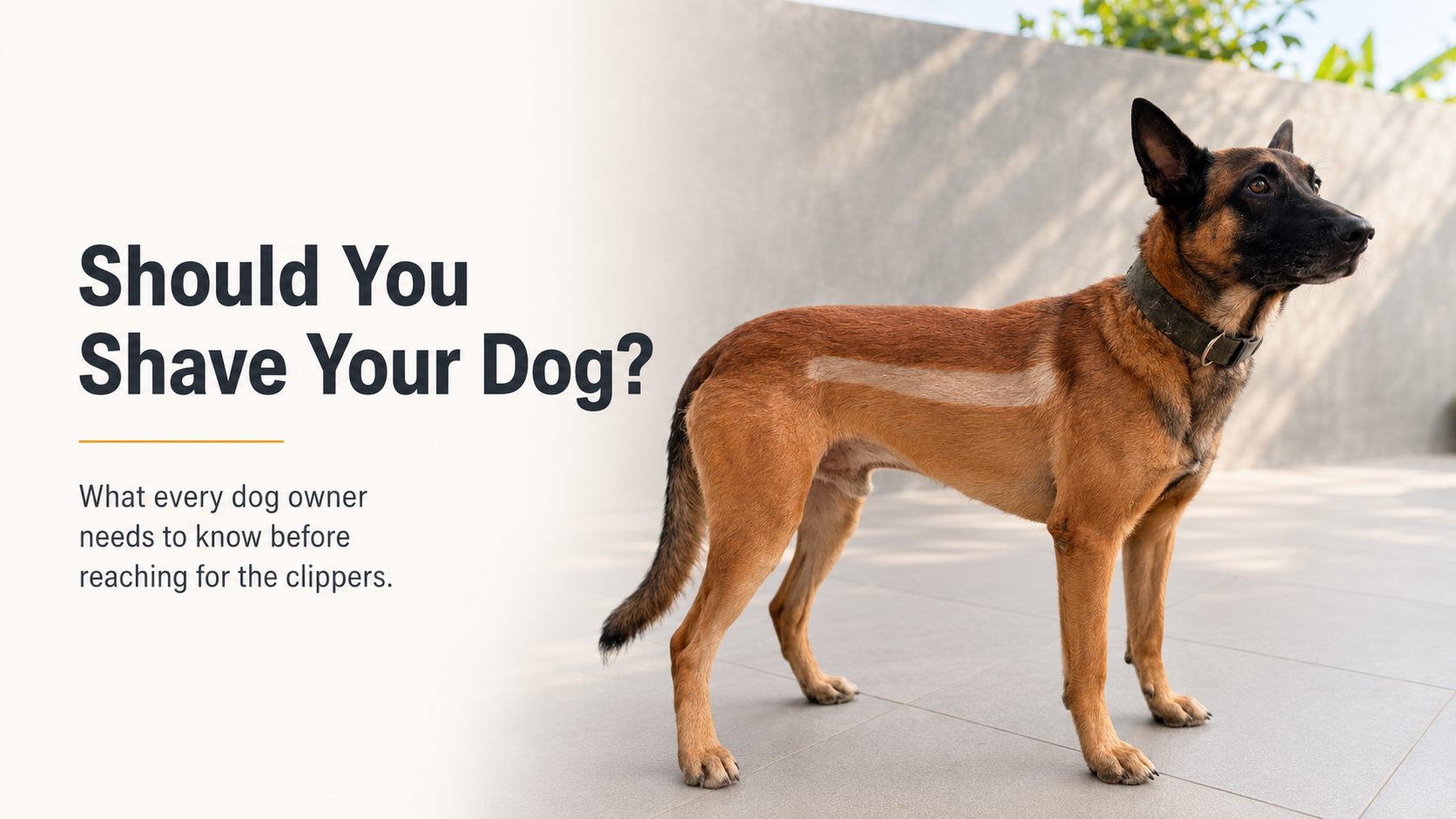
A few weeks ago I did something that gets people very worked up on the internet. I shaved the undersides of both Malinois.
What I actually did and what I observed
Not a full shave. Not down to the skin. Just the underside, the belly, the inner thighs, the chest. The areas that make contact with the floor when a dog stretches out, and the areas closest to major blood vessels.
Arya, for what it's worth, has always been clipped. She is a Springer Spaniel living in Southeast Asia. The comfort argument is obvious. So is the practical one. Anybody who has walked a Springer through undergrowth and seen what comes back with them will understand immediately. The clip is not controversial in her case. Nobody argues about Springer coat management online because the alternative is too self-evidently miserable.
With the Malinois, I want to be clear about what this is and what it is not. It is not a scientific study. I did not run a control group. I cannot prove causation.
What I can tell you is what I observed. Both dogs seem more comfortable. Risk, who normally seeks out every square centimetre of cool tile he can find and was panting heavily during the afternoons, is noticeably less bothered. He settles on the tiles now and cools off faster than he used to. The panting has reduced. Both dogs seem to decompress more easily during the hottest part of the day.
Could I be wrong? Of course. Could there be confounding factors? Always. But if the choice is between what a Facebook comment says and what I can see with my own eyes in dogs I know intimately, I'm backing the dogs in front of me.
Also, the go-faster stripes look cool as hell.
What the internet says, and why most of it is wrong
The standard response when you mention shaving a double-coated dog online is immediate. You will ruin the coat. You will remove their natural insulation. You will cause coat funk. Have you seen the thermal images?
I had seen the thermal images. That is actually part of what prompted me to look into this more carefully.
Cat the Vet posted a reel recently questioning whether double coats really have the magical cooling properties people claim. It got me thinking. So I went looking for proper science rather than Facebook folklore, and I found it.
Dr. David Marlin is a physiologist and biochemist with a PhD from Loughborough University. He has spent decades working in animal sport science, veterinary research, and exercise physiology. He is not a grooming influencer with a strong opinion. He is someone who understands how bodies actually manage heat.
His position, based on the science, is unambiguous.
One of the most persistent myths is that a dog's coat insulates against the heat. A dog's coat can protect against external heat, but only if the dog itself is not continually generating internal heat, which of course it is. Just like a well-insulated house will trap heat from a fire burning inside, a dog's coat holds in the heat generated by its metabolism. In hot weather, the coat can actually slow down the dog's ability to lose heat, not help it stay cool.
Those thermal images that circulate every summer, showing a half-clipped dog with the coated side appearing cooler? They don't prove that dogs are cooler with their coats on. They show that the coat is preventing heat loss through the skin, trapping it underneath.
That is the opposite of the argument people are making when they share them.
What a registered vet nurse said
After I posted about shaving the undersides of my dogs, I got the usual mix of responses. Most were supportive. A few were not. But one comment stood out, from Shayler Owens, a registered veterinary nurse working in a specialist referral centre for orthopaedics and soft tissue surgery.
She wrote: "We have to shave pets' limbs and bodies down to skin level to aseptically scrub and perform sterile surgical procedures. We see so many double-coated breeds and never ever have I seen dogs that I have skin-level shaved come back with any coat issues. Sure it takes a long time to grow back, as any coat or hair would."
This is worth sitting with. In surgical settings, double-coated dogs are routinely shaved completely. Not trimmed. Shaved to skin. And the coat grows back.
The "you will ruin the coat forever" argument does not hold up under much scrutiny.
The actual risk worth worrying about
None of this means you should shave every dog you see. Context matters, as it does in most things.
Dr Marlin is clear that clipping can be a lifesaving measure, especially for dogs at high risk of heat stroke, including large breeds, dogs with thick or dark coats, overweight or unfit dogs, older dogs or those with chronic conditions, and dogs with heart or respiratory issues.
He is equally clear that while clipping may sometimes lead to abnormal hair regrowth, this is a small price to pay compared to the dangers of heat stroke.
That is the risk calculation. A potentially unusual patch of regrowth on one side, heat stroke and death on the other.
The real signs to watch for are heavy panting at rest, excessive drooling, red or purple gums, glassy eyes, weakness, or a body temperature above 40 degrees Celsius. If you are seeing any of those, you are already behind. Prevention is the job.
What I actually do day to day in Vietnam
Beyond the clip, the management side is straightforward but non-negotiable in this climate.
Exercise happens at five or six in the morning or after dark, and always near water. A river or the beach. Not because I planned it that way aesthetically, but because natural water is the most effective cooling tool available and dogs who can choose to wade in will use it. They regulate themselves far better when that option exists than they ever would with a garden hose.
Inside, the air conditioning runs through the day. I know their baselines well, built over years of training and competing in Spanish summers, which taught me more about managing working dogs in heat than any other period of my life. I am not watching them constantly, but I know what normal looks like for each of them individually. I know what Risk looks like when he is genuinely comfortable versus just tolerating conditions. Since the clip, the comfortable version is showing up more often and for longer.
That individual knowledge matters more than any single intervention. Risk runs hot. Fizz manages better. Arya, now that she has always been clipped, is visibly unbothered. CeeCee, who has approximately zero body fat and would appreciate a radiator in July, is a different conversation entirely.
The bottom line
The idea that a dog's coat is a magical thermal management system that must never be interfered with is not supported by the science. It is a myth that has been repeated so many times it has started to sound like fact.
That does not mean shaving every dog everywhere is the answer. It means paying attention to your individual dog, in your individual climate, and making decisions based on what you can actually observe rather than what someone on the internet insists you must never do.
I live in Vietnam. It is 38 degrees outside before lunch. My dogs are comfortable. I will take that over coat purity every time.
Full credit to Dr. David Marlin for the science referenced in this piece. His full article on clipping, thermal imaging, and heat stroke is well worth reading: askanimalweb.com